
Tabloid Paper Guide: Dimensions, Uses, Weights & Printing Tips
Tabloid paper offers double the surface area of standard letter paper, bridging the gap between everyday office prints and high-impact posters. This complete guide covers ANSI B dimensions, Tabloid versus Ledger orientation, paper weight selection, pricing factors, and pre-press setup tips for printing flawless wide-format projects and folded booklets.

Awais M · Custom Packaging Specialist
Awais M helps small and mid-sized brands get custom packaging right — the box style, the material, the print finish, and the order quantity that actually fits the budget.
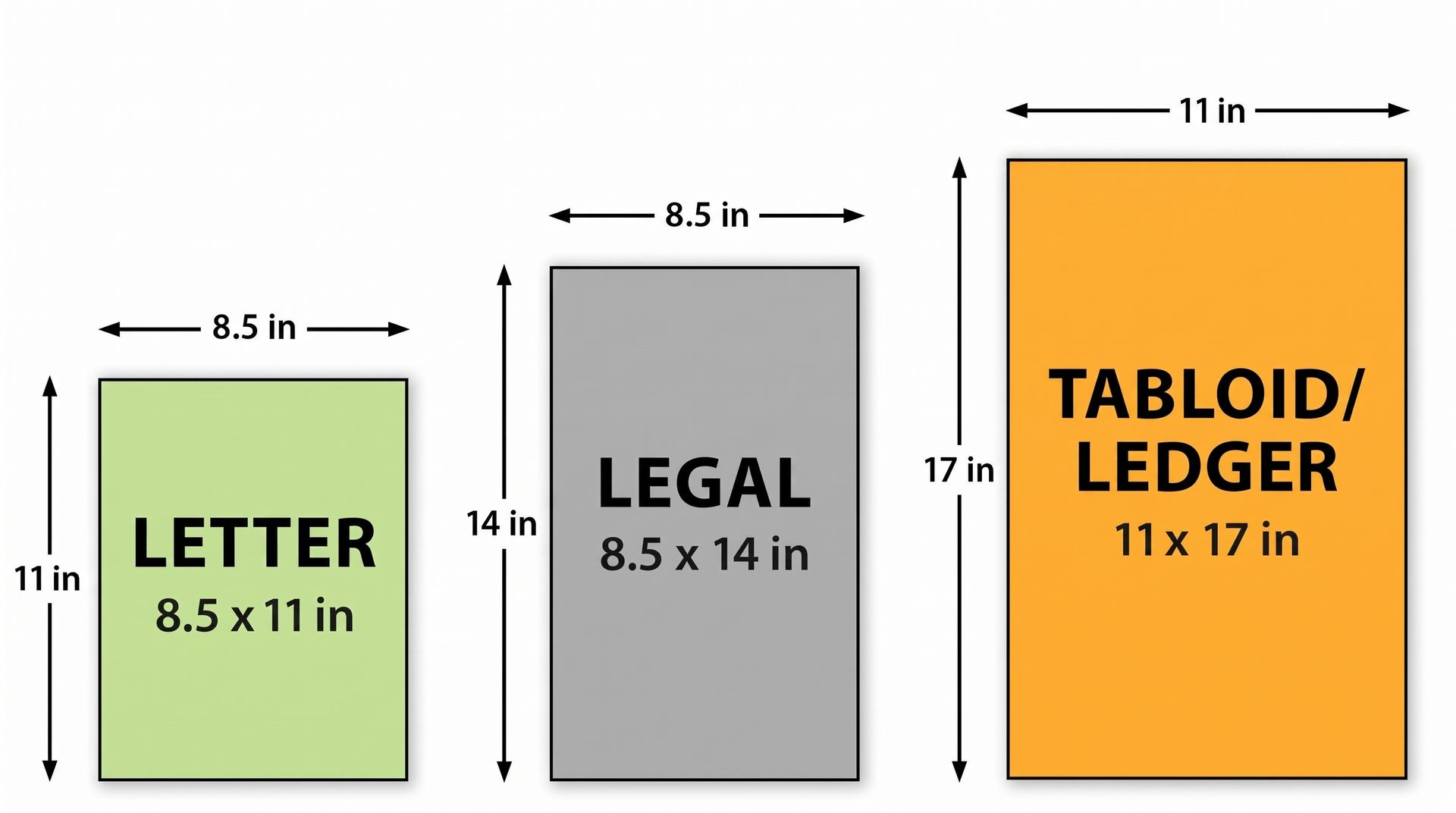
When standard letter-sized paper feels too cramped for your content and full-scale posters are too unwieldy, tabloid paper emerges as the ultimate middle ground. Offering twice the surface area of a standard sheet, this versatile format provides graphic designers, business owners, and print buyers with the expansive canvas needed to command attention without breaking the bank.
However, navigating large-format paper options often leads to confusion. Is Tabloid the exact same thing as Ledger paper? How does it differ from international A3 sheets, and when should you choose it over standard commercial poster sizes? Misinterpreting these dimensions can result in cropped artwork, unexpected scaling errors, or costly reprints at the print shop.
To eliminate the guesswork, this guide breaks down everything you need to know about tabloid paper. We will explore its exact physical measurements, clarify naming conventions, dive into primary industry applications, analyze paper weights and finishes, examine key pricing dynamics, and share essential print setup tips to ensure your next large-format project prints flawlessly.
What is Tabloid Paper?
Tabloid paper is a standard large-format paper size widely used across North America for printing newspapers, architectural plans, posters, and multi-page marketing collateral.
ANSI B Classification
In formal technical standards, tabloid paper belongs to the American National Standards Institute (ANSI) sizing system, designated specifically as ANSI B. Built around standard US letter dimensions of 8.5” x 11”, the ANSI system scales up by doubling the surface area of the previous size. ANSI B (Tabloid) is created by joining two standard ANSI A (Letter) sheets side-by-side.
Tabloid vs. Ledger: The Orientation Distinction
While the terms Tabloid and Ledger are often used interchangeably because they share the exact same physical dimensions, their technical distinction comes down entirely to orientation:
Tabloid: positioned in vertical (portrait) orientation.
Ledger: positioned in horizontal (landscape) orientation (commonly used for wide financial spreadsheets and accounting ledgers).
Tabloid vs. International Standard (A3)
North American paper sizes differ from the international ISO 216 standard used across Europe, Asia, and Latin America. Tabloid paper is the closest North American equivalent to international A3 paper, though their dimensions vary slightly:
Format Standard | Paper Name | Dimensions (Inches) | Dimensions (Millimeters) |
ANSI (North America) | Tabloid | 11” x 17” | 279.4mm x 431.8mm |
ISO 216 (International) | A3 | 11.7” x 16.5” | 297mm x 420mm |
(Notice that Tabloid paper is slightly narrower but longer than ISO A3).
Why It’s Called "Tabloid"
The term originated in late 19th-century journalism. British news publishers adopted a compact newspaper format that was significantly smaller and easier to hold than massive, full-page "broadsheet" newspapers. Over time, the condensed, sensationalist print style carried in these smaller publications earned them the name "tabloid newspapers," eventually turning "tabloid" into the universal term for 11” x 17” sheets.
Common Uses & Industry Applications
Tabloid paper’s expansive surface area and clean folding capabilities make it a staple across several key sectors:
Publishing & Media: Widely used for printing independent weeklies, community newspapers, campus press, trade journals, and local event gazettes that require a traditional newsprint feel in a manageable size.
Marketing & Advertising: High-visibility collateral such as small event posters, retail window graphics, hanging wall menus, and high-impact store signage fit naturally on an 11” x 17” format.
Corporate & Technical: Ideal for printing complex financial spreadsheets (in landscape ledger format), CAD engineering schematics, architectural floor plans, and corporate presentation boards where intricate details demand clear visibility.
Design & Collateral: Frequently used to produce 4-page folded brochures, saddle-stitched event programs, multi-panel infographics, and mini-catalog inserts that fold down neatly to standard letter size.
Paper Weights, Calipers & Finishes
Selecting the appropriate paper density and surface treatment ensures your tabloid prints look professional, withstand handling, and print smoothly:
Understanding Weight Categories
Bond / 50 lb. – 60 lb. Text: Lightweight stock best suited for everyday office copying, draft blueprints, internal memos, and high-volume press printing.
Bond / 70 lb. – 80 lb. Text: Mid-weight paper offering excellent opacity to prevent ink show-through—ideal for double-sided newsletters, restaurant menus, and vibrant color flyers.
80 lb. – 100 lb. Cover / Cardstock: Durable heavyweight cardstock designed for promotional event posters, premium presentation covers, counter displays, and long-lasting signage.
Surface Finish Options
Uncoated / Bond: Features a natural, non-reflective texture that absorbs ink quickly—making it ideal for easy writing, stamping, and high-readability text documents.
Gloss Coated: Smooth, reflective coating that makes colors pop, perfect for photo-heavy graphics, promotional posters, and sleek promotional covers.
Matte / Satin Coated: Delivers a smooth, glare-free finish with rich color accuracy, offering an elegant balance for architectural drawings, maps, and upscale food menus under direct lighting.
Price Dynamics & Cost Factors
Understanding how paper properties impact production expenses helps graphic designers and print buyers optimize project budgets without sacrificing output quality:
Average Retail Pricing
Tabloid paper is generally sold in reams of (or cases of to ). Prices vary based on weight and finish:
Standard Uncoated Bond: Approximately $18 – $30 per ream (ideal for high-volume drafting and internal printing).
Premium Heavyweight / Bright White: Ranging from $35 – $55 per ream (ideal for color flyers, menus, and newsletters).
Cover / Cardstock: Ranging from $60 – $100+ per ream, depending on gloss/matte coatings and specialized paper treatments.
Key Cost Drivers
Paper Weight & Thickness (Caliper): Heavier text and cover stocks require more raw pulp fiber during manufacturing, directly increasing the cost per sheet and shipping weight.
Coated vs. Uncoated Finishes: Specialty gloss, matte, or satin chemical coatings add production steps, making coated papers more expensive than standard uncoated bond paper.
Order Volume & Production Method: Bulk ream orders and high-volume offset runs significantly decrease the unit price per sheet compared to short-run, on-demand digital printing.
Specialty Eco & Performance Features: Papers featuring high brightness ratings (Brightness), post-consumer recycled content or Forest Stewardship Council (FSC) eco-certifications carry a slight price premium over standard sheets.
Printing & Setup Tips for Tabloid Paper
Proper pre-press setup ensures your large-format artwork translates crisp details accurately from screen to physical paper without unexpected trimming or resolution loss:
Printer Compatibility: Verify that your office printer or commercial press explicitly supports Wide-Format / 11” x 17” stock. Most commercial printers handle tabloid paper using a dedicated wide-format tray or a manual bypass tray configured for custom paper sizes.
Bleed & Crop Marks: For edge-to-edge printing (full bleed), extend your background elements beyond the trim edge by adding a standard 0.125” (1/8 in) bleed on all sides. This expands your final artwork canvas to 11.25” x 17.25”. Enable crop marks in your design software so the commercial cutter knows exact trim boundaries.
Resolution Requirements: To keep imagery, logos, and fine text sharp across an expanded surface area, set all raster images and artwork files to a minimum of 300 DPI at actual scale (3300 x 5100 pixels). Lower resolution graphics (72 DPI – 150 DPI) will appear blurry or pixelated when enlarged to tabloid size.
Browse other products: Birthday cards, envelopes, bookmarks, and booklet.
Key Takeaways
Double the Canvas: Tabloid paper 11” x 17” provides exactly twice the printable surface area (187 sq. inches) of standard US letter paper 8.5” x 11”, bridging the gap between everyday office sheets and large wall posters.
Orientation Defines the Name: While sharing identical physical dimensions, Tabloid refers to vertical (portrait) orientation (), whereas Ledger refers to horizontal (landscape) orientation ().
US Standard vs. International: Tabloid paper is the ANSI B standard for North America. It is slightly narrower and longer than its international ISO equivalent, A3 (11.7” x 16.5”).
Built-in Booklet Efficiency: Folding a single tabloid sheet in half creates a seamless, 4-page booklet, cutting assembly, stapling, and binding costs by up to 30-40%.
Match Weight to Purpose: Use lightweight bond stock for draft schematics, mid-weight text stock to prevent double-sided show-through on newsletters, and heavy cover stock for durable posters.
Pre-Press Precision: Always add a bleed ( total canvas) for full-bleed printing and maintain a resolution of 300 DPI to prevent pixelation across large graphic layouts.
Whether you need crisp architectural blueprints, eye-catching promotional posters, or custom-printed folded brochures, The Packaging World has you covered. Explore our wide selection of premium paperboard stocks, custom finishes, and wide-format printing solutions tailored to your brand’s exact specifications.
Need custom packaging for your product?
Get pricing, samples, and expert advice — no commitment required.
Topics