
UPS Box Sizes: Standard Dimensions & DIM Weight
Shipping air in oversized boxes directly inflates dimensional (DIM) weight fees and increases product damage rates. This comprehensive guide breaks down standard UPS box dimensions, weight thresholds, and fee structures, exploring how custom-engineered corrugated boxes reduce logistics costs and protect products during transit.

Awais M · Custom Packaging Specialist
Awais M helps small and mid-sized brands get custom packaging right — the box style, the material, the print finish, and the order quantity that actually fits the budget.
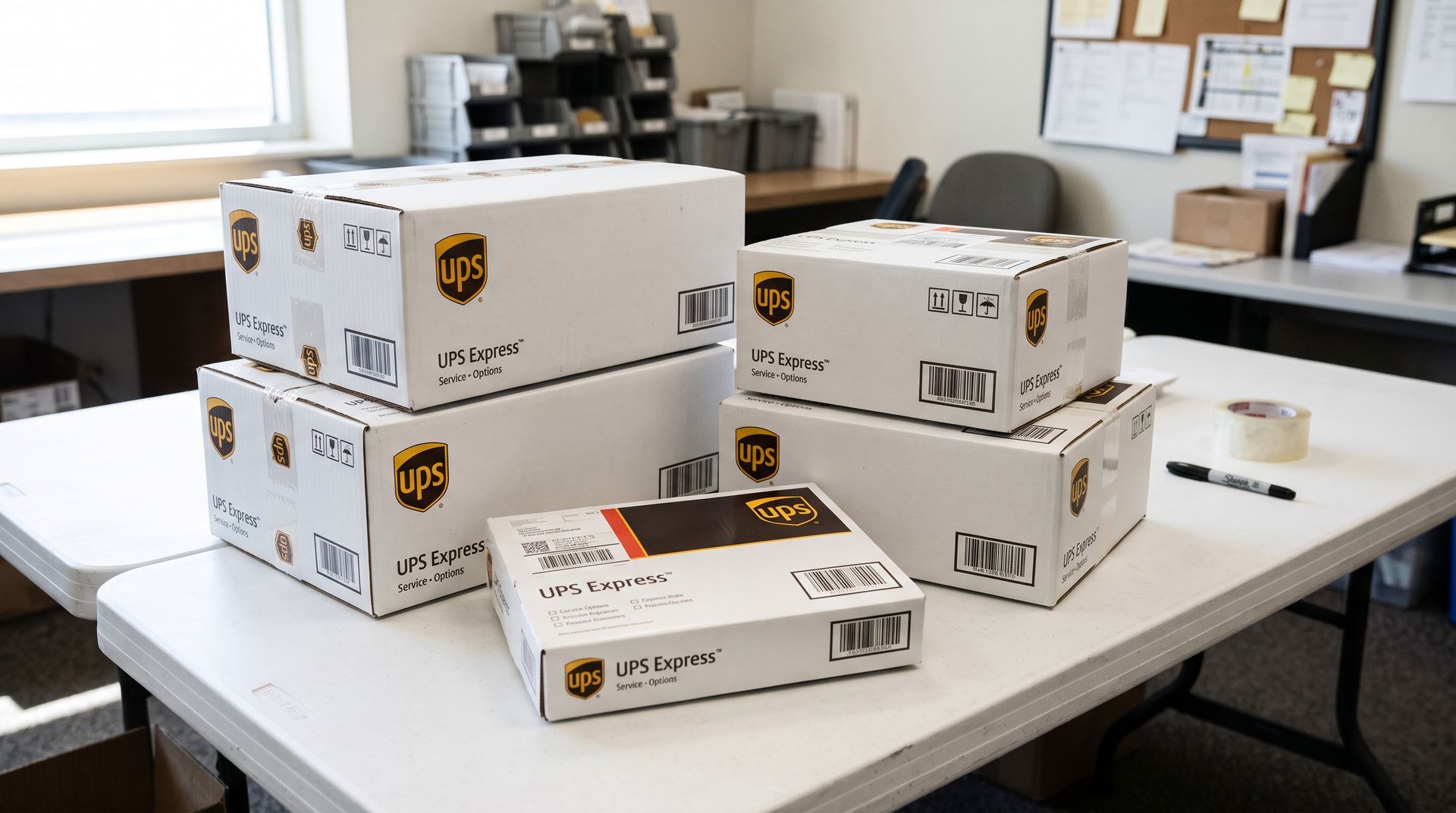
In e-commerce logistics, shipping by air is one of the fastest ways to drain profit margins. Choosing the wrong box size for UPS shipments does not just waste physical space; it directly inflates dimensional (DIM) weight fees and significantly increases product damage rates by leaving room for internal movement during transit.
When fulfilling orders through UPS, shippers generally choose between two primary packaging routes: standard carrier-provided packaging or customer-supplied custom boxes. While UPS-provided boxes offer convenient, standard options for specific expedited services, customer-supplied custom packaging gives brands total control over exact dimensions, material strength, and unboxing aesthetics.
In this guide, we will break down standard UPS box size specifications, maximum weight thresholds, and exact DIM weight formulas. We will also examine how to avoid expensive carrier surcharges and explore how custom corrugated box alternatives can lower your overall shipping costs while elevating your brand.
Standard UPS-Provided Box Sizes & Specifications
UPS provides a variety of standard packaging options tailored to specific shipment types, weights, and service levels. Utilizing the correct carrier-provided container ensures proper fit and compliance with UPS shipping standards.
Express & Small Packaging
Designed for flat documents, soft goods, and lightweight items shipped via UPS Next Day Air, 2nd Day Air, or International Express services:
UPS Express Envelope / Letter (12.5"×9.5"): Standard flat cardstock container designed for urgent legal paperwork, contracts, and business documentation up to .
UPS Express Pak (16"×11.75" or padded variations): Durable, moisture-resistant poly or padded mailers engineered for soft items like apparel, softcover books, or small unboxed goods that do not require rigid corner protection.
Standard Corrugated UPS Express Boxes
UPS offers pre-formed corrugated containers for expedited air services. These boxes feature standardized dimensions designed to optimize air cargo hold space:
Box Size | Dimensions (L×W×H) | Ideal Applications |
UPS Express Box – Small | 13"×11"×2" (33 cm×28 cm×5 cm) | Single hardcover books, thin tablets, small electronics, and compact folded apparel. |
UPS Express Box – Medium | 15"×11"×3" (38 cm×28 cm×8 cm) | Multiple soft goods, small leather accessories, jewelry boxes, and component parts. |
UPS Express Box – Large | 18"×13"×3" (46cm×33 cm×8 cm) | Flat garments, framed artwork, medium electronics, and multi-item document stacks. |
Specialty Shipping Containers
Engineered for irregular geometry or heavy international cargo:
UPS Express Tube (38"×6"×6"): Triangular corrugated container designed to secure rolled items, such as blueprints, architectural plans, maps, posters, and fabric rolls, preventing them from rolling during automated belt sorting.
UPS World Ease & Heavyweight Containers: Reinforced, high-test corrugated structures designed for consolidated international shipments. These containers hold multiple individual packages bound for a single destination to clear customs as a single clearance unit.
UPS Weight Limits & Dimensional Weight (DIM) Calculation
Understanding how UPS evaluates package weight and volume is essential to controlling shipping expenses and ensuring package acceptance across their logistics network.
Maximum Weight & Size Thresholds
Packages exceeding standard operational thresholds risk rejection at pickup, delayed transit, or steep oversize penalties.
Maximum Weight per Package: Packages can weigh up to (). Any shipment above requires a dedicated heavy-package warning label attached near the main shipping label.
Maximum Length: The single longest side of the package cannot exceed 108 inches (274 cm).
Maximum Length + Girth: Combined length and girth must not exceed 165 inches (419 cm). Girth is calculated around the package's two smallest dimensions:
Length+(2×Width)+(2×Height)
Understanding Dimensional (DIM) Weight
UPS calculates billing rates using Dimensional (DIM) Weight, a pricing model based on volume rather than scale weight alone. This ensures shippers pay for the cargo space a container occupies inside sorting facilities and delivery vehicles.
The Formula
To find a package's dimensional weight in pounds, multiply its outer dimensions (rounded up to the nearest whole inch) and divide by the standard UPS domestic divisor(139):
"DIM Weight (lbs)"=(Length ×Width ×Height (inches) )/139
Billable Weight
UPS determines final shipping charges using Billable Weight, which is whichever value is greater: the actual scale weight or the calculated DIM weight.
Billable Weight=max(Actual Weight ,DIM Weight)
If a box weighs on the scale but yields a DIM weight of based on its outer measurements, UPS bills the package at the rate.
The Impact of Void Space
Using oversized stock boxes creates excess interior void space that must be filled with bubble wrap, paper, or air pillows. Excess void space forces you to pay carrier rates for shipping empty air while increasing the risk of internal movement and product damage. Right-sizing containers to fit product contours directly minimizes billable DIM weight and eliminates unnecessary dunnage costs.
Surcharges to Avoid: Additional Handling & Over Maximum Limits
Failing to optimize container dimensions or exceeding carrier physical boundaries can trigger steep unexpected fees. UPS enforces precise surcharge rules to cover the operational cost of manually processing oversized or non-standard packages.
Additional Handling Surcharge (AHS)
The Additional Handling Surcharge applies when a shipment requires special manual processing or cannot pass through automated conveyor sorting belts. AHS is triggered if a package meets any of the following criteria:
Dimension Limits: The longest side exceeds 48 inches (122 cm), or the second-longest side exceeds 30 inches (76 cm).
Weight Limit: Actual weight exceeds 50 lbs (23 kg).
Packaging Type: The item is not fully encased in a standard outer corrugated cardboard shipping box.
Large Package Surcharge
A package is classified as a "Large Package" when its combined length and girth exceeds 130 inches (330 cm), but remains below the absolute maximum limit of 165 inches.
Calculation: Length+(2×Width)+(2×Height)>130 inches .
Billing Minimum: Large packages are subject to a minimum billable weight of 90 lbs (41kg), regardless of their actual scale weight, alongside the baseline large package fee.
Over Maximum Limits Fee
Packages that breach absolute carrier network limits are subject to extreme penalties and risk being refused or returned to the sender. This fee is billed when a package exceeds:
Weight: Over 150 lbs (68 kg).
Length: Over 108 inches (274 cm).
Combined Size: Length + Girth exceeding 165 inches (419 cm).
Non-Standard Packaging Material Rules
UPS applies packaging charges to items that bypass standard corrugated boxes, as irregular surfaces disrupt conveyor flow and require manual routing:
Metal, wood, or hard plastic containers without an outer corrugated wrapping.
Cylindrical items (canisters, buckets, drums, or tires) that roll on automated belts.
Soft-sided bundles or soft mailers wrapped in heavy plastic film or fabric canvas.
Custom Box Sizes vs. Standard UPS Packaging
While carrier-provided boxes offer convenient off-the-shelf options, relying solely on standard sizes often leads to paying premium rates for unused interior volume. Transitioning to custom corrugated packaging gives businesses total control over dimensional weight, structural integrity, and brand presentation.
Limitations of Standard Carrier Boxes
Standard UPS packaging is built to generic, one-size-fits-most dimensions. When shipping items with unique proportions, these fixed sizes create several operational drawbacks:
Inflated DIM Weight Costs: A standard carrier box that is even 2 to 3 inches too large across each dimension significantly expands total cubic volume, pushing the package into a higher billable weight tier.
Excessive Dunnage Expense: Oversized boxes demand heavy amounts of void fill—such as air pillows, kraft paper, or foam peanuts—increasing raw material expenditure and packing labor times.
Generic Brand Experience: Stock carrier containers feature standard carrier branding, missing the opportunity to leverage custom graphics, bold colors, and premium tactile finishes on the outer shipping box.
Custom Corrugated Box Solutions
Engineering custom shipping containers allows brands to select the precise box style suited to their product's weight, fragile nature, and fulfillment workflow:
Regular Slotted Cartons (RSC): The industry standard for cost-efficient, high-strength shipping. All flaps meet at the center, making RSC containers ideal for bulky, heavy, or multi-item shipments that require maximum structural rigidity.
Roll End Tuck Top (RETT / C-Series): Features self-locking side walls and a hinged lid that opens upward. These boxes provide a clean, high-end unboxing presentation for direct-to-consumer (D2C) e-commerce, beauty, and retail goods without requiring exposed tape seams on top.
Auto-Bottom Cartons: Designed with a pre-glued base that snaps into shape instantly upon assembly. These containers dramatically cut down packing times in high-volume fulfillment warehouses.
Browse formats: retail boxes, cosmetic boxes, or food boxes.
Optimizing Dimensions for Reduced UPS Rates
Custom packaging aligns your box's length, width, and depth directly to the outer contours of your product (plus necessary internal protective cushioning).
By shrinking outer measurements to the exact millimeter needed, you eliminate wasted cubic inches. This keeps calculated dimensional weight as close as possible to the actual scale weight, helping your business avoid unexpected DIM weight jumps, pass beneath key surcharge thresholds, and lower overall freight spending across every shipment.
Protection & Structural Guidelines for UPS Transit
UPS sorting hubs utilize high-speed automated sorting belts, gravity chutes, and multi-tiered stacking vehicles. Ensuring your shipments survive transit without damage requires selecting the right board strength, internal cushioning, and box sealing methods.
ECT (Edge Crush Test) vs. Mullen Test Standards
Corrugated board strength is measured using two industry-standard metrics: ECT (stacking strength) and Mullen/Bursting Test (puncture resistance). Selecting the correct board grade prevents side-wall buckling during stacking.
Package Weight Limit | Minimum ECT Rating | Minimum Mullen Rating | Recommended Application |
Up to 30 lbs (14 kg) | 32 ECT | 200 lbs/sq in | Standard e-commerce parcel shipping for lightweight retail goods. |
30 to 65 lbs (14 to 29 kg) | 44 ECT | 275 lbs/sq in | Medium-to-heavy items, dense electronics, and fragile glass products. |
65 to 120 lbs (29 to 54 kg) | 48 ECT or 51 ECT | 350 lbs/sq in | Heavy machinery parts, bulk liquids, and heavy industrial equipment. |
Internal Cushioning Rules
Proper internal protection prevents items from moving inside the box and absorbs kinetic shock when packages drop or shift during transit.
The 2-Inch Rule: Maintain a minimum of 2 inches (5 cm) of shock-absorbing void fill between the contents and all six inner walls of the outer corrugated box.
Cushioning Materials: Use high-density bubble wrap, custom die-cut corrugated or foam inserts, or compressed kraft paper. Loose-fill foam peanuts are not recommended for heavy items because contents settle to the bottom during vibration.
Fragile Multi-Item Isolation: Wrap fragile items individually and separate them with corrugated dividers or custom inserts to prevent item-to-item collisions inside the container.
Sealing Requirements & "H-Taping" Method
Proper box sealing secures structural integrity and prevents flaps from opening under pressure.
Tape Selection: Use heavy-duty, pressure-sensitive plastic packaging tape or water-activated reinforced gummed paper tape at least 2 inches (5 cm) to 3 inches (7.5 cm) wide. Cellophane, masking, or household duct tape should never be used.
The "H-Taping" Method: Apply tape across all seams of both the top and bottom flaps to form an "H" pattern:
Seal the center seam where the major flaps meet.
Seal both edge seams along the outer ends of the box.
This technique distributes stress across the entire box surface, prevents corner tears, and shields the package interior from dust and moisture.
Can I send UPS Box through USPC?
No, you cannot send a UPS-provided shipping box directly through USPS using standard USPS postage.
USPS guidelines prohibit shipping carrier-branded boxes (such as UPS, FedEx, or DHL) through their postal network if the carrier's logos are clearly visible. If you attempt to drop off a UPS box at a USPS Post Office or in a mailbox, it will typically be rejected at the counter or returned to the sender.
Your Options if You Want to Use USPS:
Cover or Wrap the Box: If the box is structurally sound and you still want to use USPS, you must completely obscure all UPS logos, trademarks, and barcodes. You can wrap the box in heavy brown kraft paper, cover the branding with opaque shipping tape, or turn the box inside out (if it allows without compromising structural strength).
Use a Standard / Plain Corrugated Box: The easiest approach is to transfer your item into an unbranded plain shipping box (or custom box) before applying a USPS shipping label.
Use UPS Parcel Select / Hybrid Shipping Services: In certain logistics partnerships (like UPS SurePost or Mail Innovations), UPS carries the package through its network for the long haul, and USPS performs the final delivery. However, these packages are still tendered to UPS initially, not handed over directly to USPS.
If you are using an official UPS-provided box (such as a UPS Express Box or Pak), it must be shipped exclusively through UPS.
Where to Order Custom Boxes?
Whether you need to lower your UPS dimensional weight charges with custom-fit shipping boxes or upgrade your brand presentation with high-strength corrugated mailers, The Packaging World provides engineered packaging solutions built for maximum transit protection and minimum freight costs.
Exact-Fit Dielines: Stop paying extra DIM weight fees by ordering custom corrugated boxes tailored to your exact product dimensions.
Structural Durability: Choose from high-grade 32 ECT to 44+ ECT single-wall and double-wall board options designed to meet strict carrier standards.
Custom Branding & Inserts: Elevate customer unboxing with vibrant full-color printing, protective die-cut foam, and custom corrugated inserts.
Need custom packaging for your product?
Get pricing, samples, and expert advice — no commitment required.
Topics
Industries