
The Standard Baseball Card Size: Dimensions, Formats & Packaging Guide
A fraction of a millimeter can mean the difference between a mint-condition gem and a card with crushed corners. Whether you are a collector organizing a vintage set, a seller selecting protective top-loaders, or a brand manufacturing custom trading card boxes, precision measurements are everything. Explore our comprehensive guide to standard baseball card size dimensions (2.5"×3.5"), card point thickness calculations.

Awais M · Custom Packaging Specialist
Awais M helps small and mid-sized brands get custom packaging right — the box style, the material, the print finish, and the order quantity that actually fits the budget.
In the world of collectibles and custom print manufacturing, precise measurements dictate value. A fraction of a millimeter can mean the difference between a mint-condition gem and a card with crushed corners due to a poor-fitting storage box. Whether you are a collector organizing a vintage set, a manufacturer building branded packaging, or a designer launching a new custom card series, mastering exact baseball card size dimensions is essential.
Standard Baseball Card Dimensions (The Universal Industry Standard)
The modern standard for a standard baseball card is 2.5 inches by 3.5 inches. This dimensional standard applies across virtually all modern sports cards, trading card games (TCGs) like Pokémon and Magic: The Gathering, and standard custom collector cards.
Measurement Unit | Width | Height |
Inches | 2.5" | 3.5" |
Millimeters | 63.5 mm | 88.9 mm |
Centimeters | 6.35 cm | 8.89 cm |
Pixels (at 300 DPI - Print Quality) | 750 px | 1050 px |
Why 2.5"×3.5" Became the Standard
In the early days of card manufacturing, sizes varied wildly based on tobacco packaging or bubblegum wrapper constraints. In 1957, Topps established the standard to streamline high-speed printing, die-cutting, and automated packaging lines. This format quickly became the global standard, dictating the design of binder pages, protective sleeves, and storage boxes for decades to come.
Understanding Baseball Card Thickness (Point Sizes Explained)
While surface dimensions (2.5"×3.5") remain uniform, card thickness varies significantly. In the card industry, paperboard thickness is measured in Points (pt), where 1 pt equals 0.001" inches.
Inserting a thick autograph or relic card into a standard top-loader will pinch the surface and ruin the card’s grade. Knowing the exact point size is critical when selecting protective holders or designing internal box depths.
Card Point Size | Thickness in Inches | Typical Card Types |
20pt – 35pt | 0.020"-0.035" | Standard paperboard cards (Base Topps, Panini, Bowman). |
50pt – 75pt | 0.050"-0.075" | Premium foil-stamped, thick stock, or thin relic cards. |
100pt – 130pt | 0.100"-0.130" | Standard jersey swatch and single-patch relic cards. |
180pt – 360pt | 0.180"-0.360" | Ultra-thick multi-patch, jumbo patch, and booklet cards. |
Vintage & Non-Standard Baseball Card Sizes
Before the 1957 standardized format, card dimensions were dictated by whatever product they were bundled with, from cigarette packs to candy boxes.
T206 Tobacco Cards (1909–1911): 1.4375"×2.6875" (36.5 mm×68.2 mm). Famous for the Honus Wagner card, these small cards required specialized narrow sleeves.
1951 Topps Red/Blue Backs: 2"×2.625". A shorter, wider format used during Topps' early experimental years.
1952–1956 Topps (Bowman Era): 2.625"×3.75". Known as "vintage oversized" cards, these are wider and taller than modern cards and require specialized storage supplies.
Jumbo Box Toppers & Oversized Cards: Often 5"×7", designed as promotional inclusions in wholesale box cases.
Protective Storage & Display Dimensions
To preserve value, cards are layered in protective enclosures. When building storage packaging, you must account for the outer footprint of these protective layers rather than just the raw card dimensions.
1. Penny Sleeves & Toploaders
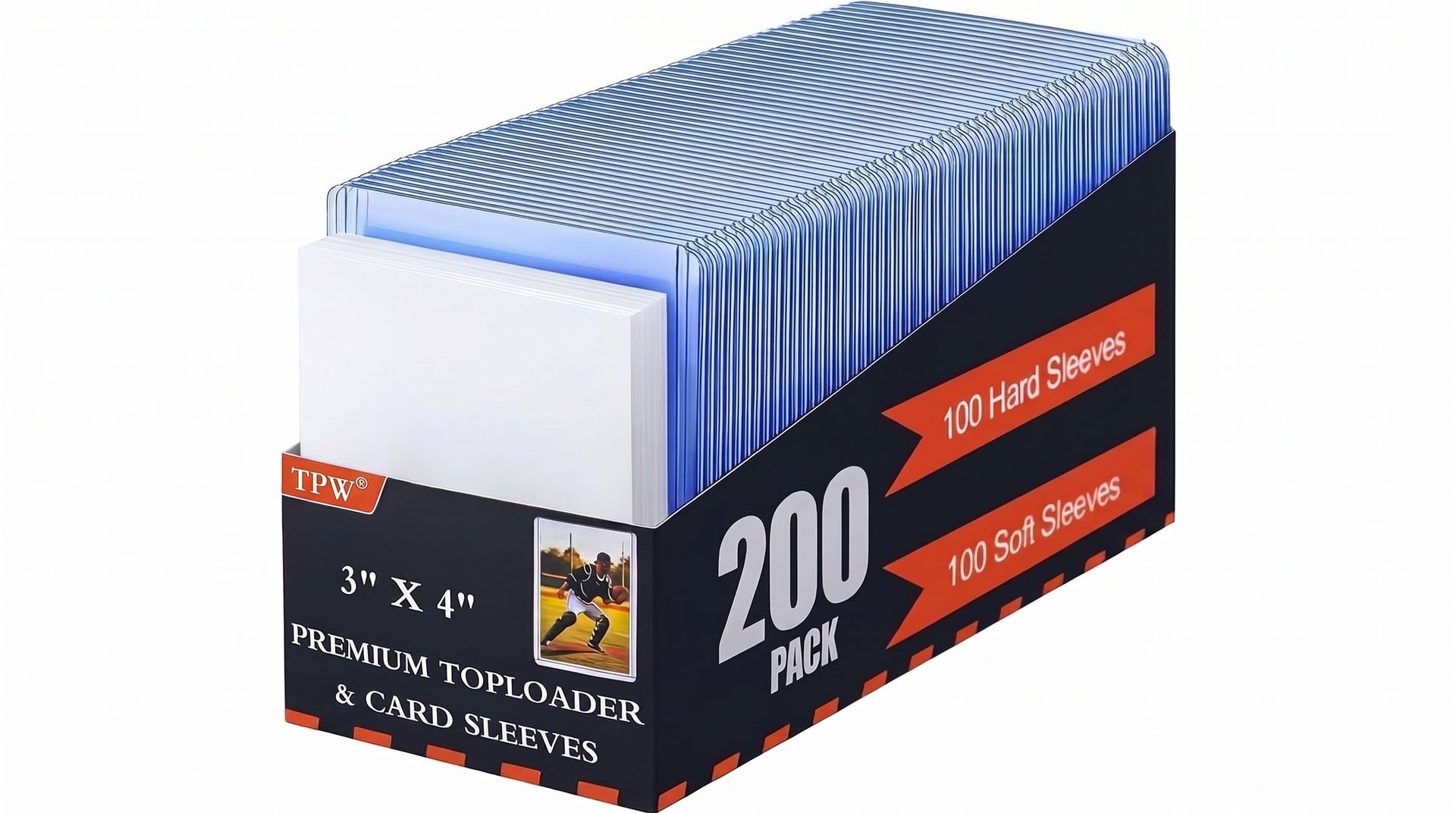
A standard penny sleeve measures roughly 2.625"×3.625", providing a soft polypropylene buffer against surface scratches. Rigid PVC toploaders hold these sleeved cards, measuring approximately 3"×4".
2. Standard 9-Pocket Binder Pages
Archival binder sheets feature 9 pockets, each sized slightly above 2.5"×3.5" (typically 2.7"×3.7") to allow smooth insertion of sleeved cards without bending the corners.
3. Graded Card Slabs (PSA, BGS, SGC)
Graded cards encased in sonically sealed hard plastic slabs demand significantly larger storage space:
PSA Slab Outer Dimensions: Approx. 3.13" wide"×5.38" high"×0.25" thick".
· BGS (Beckett) Slab Outer Dimensions: Approx. 3.25" wide"×5.25" high"×0.30" thick".
Custom Packaging & Storage Box Considerations
When manufacturing custom trading card boxes, whether for single retail packs, 800-count storage units, or luxury display cases, precision measurements determine success.
Accounting for Tolerance: Never size a box to exactly 2.5"×3.5". Always add 0.0625" to " 0.125" of inner clearance to allow cards to slide out smoothly without corner friction.
Material Selection:
Folding Cartons (18pt–24pt Cardstock): Ideal for retail booster packs and small 10–30 card sets.
E-Flute Corrugated: Essential for heavy, multi-row bulk storage boxes (800-count to 3,200-count "Monster Boxes") to prevent wall collapse.
Rigid Chipboard: Best suited for high-end limited-edition card releases or slab storage cases, offering maximum crush resistance.
Key Takeaways for Collectors and Brands
Standard Size: Modern cards measure 2.5"×3.5" (63.5 mm×88.9 mm).
Thickness Matters: Point sizes range from 20pt to 360pt; measuring thickness ensures correct top-loader and box depth selection.
Account for Protection: Custom boxes meant for graded or top-loaded cards must be sized for the outer slab footprint (3.13"×5.38"), not the raw card size.
Need precision-engineered custom boxes or branded retail packaging tailored to your exact card deck dimensions? The Packaging World delivers specialized, custom card packaging solutions built to protect and elevate your collection.
Need custom packaging for your product?
Get pricing, samples, and expert advice — no commitment required.
Topics
Industries