
Standard Postcard Size: USPS Rules & Print Specs
Picking the wrong postcard size can double your postage costs before your artwork hits the press. This comprehensive guide breaks down standard commercial postcard dimensions (4''×6'', 5''×7'', 6''×9'', and 6''×11''), USPS First-Class and EDDM mailing regulations, paper stock selections, and print-ready bleed requirements for maximum direct mail ROI.

Awais M · Custom Packaging Specialist
Awais M helps small and mid-sized brands get custom packaging right — the box style, the material, the print finish, and the order quantity that actually fits the budget.
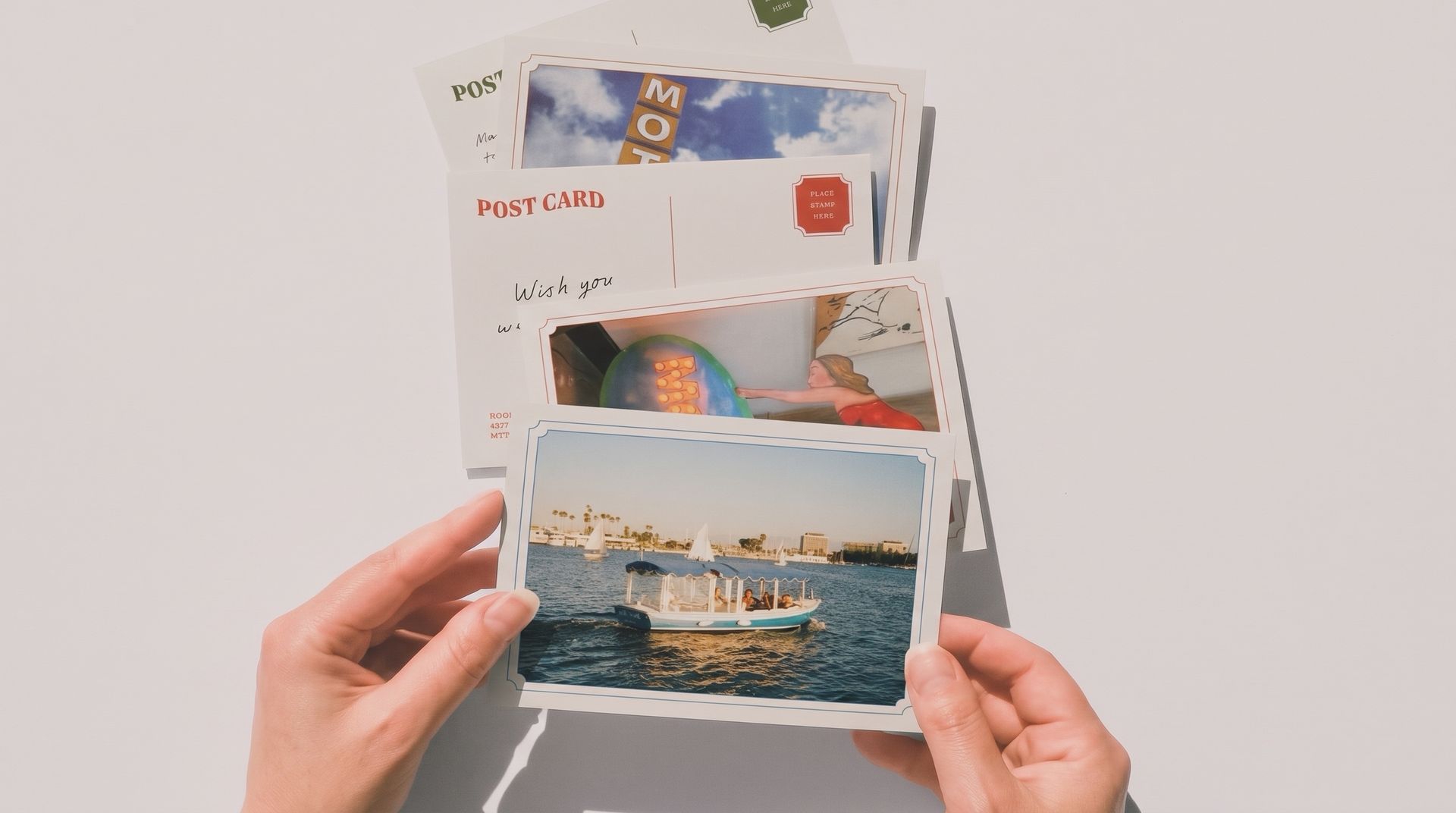
A single fraction of an inch can quietly destroy your direct mail marketing budget. Choosing the wrong postcard size often pushes your print campaign into a higher postage bracket, doubling your mailing costs before your artwork even hits the press.
In this guide, we will break down critical USPS postal regulations, file setup parameters (bleeds, safety zones, and clearance margins), paper weight selections, and campaign-specific strategies to help you choose the ideal size for your marketing goals.
Standard Postcard Dimensions (At-a-Glance Comparison)
Selecting the right postcard size involves balancing production costs, visual impact, and postage regulations. Here is how the most common standard dimensions break down:
Standard (4''×6''): The classic, budget-friendly staple. This is the maximum size allowed by the USPS to qualify for the discounted First-Class Postcard mailing rate (up to 4.25''×6''). Because it offers the lowest printing and mailing costs per unit, it is ideal for high-volume thank-you inserts, simple event reminders, and promotional discount codes.
Large / Medium (5''×7''): Offers extra visual real estate for imagery, secondary offer details, and clear calls to action without feeling bulky. While it exceeds the maximum size for the USPS Postcard rate—meaning it ships at the standard First-Class Letter rate- its compact footprint still feels familiar and manageable for recipients.
Jumbo / Half-Page (5.5''×8.5'' or 6''×9''): Designed specifically to stand out in a stack of standard mail. The half-page size gives designers enough room to combine product photo grids, feature bullet points, and store details without crowding the required address and barcode clearance zones.
Panoramic / Extra Large (6''×11''): The ultimate high-impact mailer size. This format meets the minimum USPS dimensional requirements for Every Door Direct Mail (EDDM) saturation campaigns, allowing businesses to target entire postal routes at reduced postage rates. It provides maximum surface area for complex real estate property showcases, multi-product catalogs, and local service offerings.
USPS Postcard Size Regulations & Postal Rates
Navigating postal guidelines is essential when designing direct mail. The United States Postal Service (USPS) strictly categorizes mailpieces by dimensions, weight, and thickness. Understanding these classifications ensures your postcard qualifies for the intended postage rate without unexpected surcharges.
1. First-Class Postcard Rate Requirements
To qualify for the lowest official First-Class Postcard mailing rate, your card must fit within a very specific dimensional window:
Minimum Size: 3.5''×5'' with a minimum thickness of 0.007'' (roughly equal to a standard 7pt cardstock). Anything smaller cannot be processed by automated USPS sorting machinery.
Maximum Size: 4.25''×6'' with a maximum thickness of 0.016'' (equivalent to a heavy 16pt cardstock).
Key Takeaway: The standard 4''×6'' postcard fits comfortably inside these parameters, making it the most cost-effective option for direct mail.
2. Letter Rate Classification
A common pitfall in direct mail marketing is assuming that any flat, un-enveloped piece of cardstock counts as a "postcard."
Why 5''×7'' and 6''×9'' Cards Cost More: Once a card exceeds 4.25'' in height or 6'' in length, the USPS reclassifies it as a First-Class Letter.
Impact on Budget: While popular oversized formats like 5''×7'' and 6''×9'' offer significantly more space for messaging and imagery, they are charged at the higher First-Class Letter postage rate rather than the discounted postcard rate.
3. USPS Every Door Direct Mail (EDDM) Rules
Every Door Direct Mail (EDDM) allows businesses to drop mailers into every mailbox on a designated carrier route without needing to purchase an address list. However, to qualify for EDDM saturation rates, the mailpiece must be classified by the USPS as a Flat.
Minimum Size Requirements: An EDDM piece must exceed at least one of these minimum dimensions:
Greater than 6.125'' in height OR
Greater than 10.5'' in length.
Popular EDDM Sizes: 6.25''×9”, 6''×11'', and 8.5''×11''.
Maximum Dimensions: An EDDM mailer cannot exceed 12'' in height, 15'' in length, or 0.75'' in thickness.
How to Choose the Right Postcard Size for Your Campaign
Selecting the right dimensions depends on your campaign's marketing goals, visual requirements, and target audience:
Brand Announcements & Thank You Cards (4''×6''): The standard card delivers a compact, personal feel. It offers sufficient space for a brief note, logo, and coupon code while keeping print and postage costs minimal, making it ideal for e-commerce box inserts or customer appreciation mailers.
Retail Sales & Promotional Coupons (5''×7''): A step up in size allows for striking hero imagery on the front alongside promotional details, expiration dates, and a call-to-action on the back. It captures immediate attention without overwhelming the recipient.
Real Estate & Product Showcases (5.5''×8.5'' or 6''×9''): Half-page formats offer the layout capacity needed for multi-photo grids, detailed specs, floor plans, and agent bios. They stand out in standard letter stacks and allow complex value propositions to breathe.
Saturation Direct Mail / EDDM (6''×11''): The oversized panoramic format ensures maximum visual dominance in local mailboxes. Perfect for contractors, lawn care, restaurants, and retail grand openings targeting entire zip codes via USPS Every Door Direct Mail.
Technical Design Specs: Bleeds, Safety Zones, & Postage Clearance
Preparing print-ready artwork files requires strict adherence to layout parameters to prevent awkward trimming line shifts and ensure seamless USPS automated sorting.
Bleed Area: Extend background graphics and images 0.125'' (1/8'') past the final trim line on all four sides. This extra coverage ensures edge-to-edge printing without unprinted white borders if the cutting blade shifts slightly during production. For instance, a standard postcard requires an overall artwork canvas size of 4.25''×6.25''.
Safety Zone (Margin): Keep all vital design elements—such as copy, headlines, logos, and phone numbers—at least 0.125'' (1/8'') inside the actual trim line. Positioning content within this safety margin guarantees critical information will not get sliced off during high-speed commercial cutting.
Postage & Address Clearance: The back side of direct mail cards must leave clear zones reserved strictly for postal processing:
Mailing Panel: Leave an unobstructed, white or light-colored 4''×2.25'' block in the lower-right quadrant for direct addressing, recipient labels, and Intelligent Mail Barcodes (IMb).
Indicia / Stamp Zone: Reserve a 1.0''×1.0'' box in the top-right corner clear of artwork for postage stamps, meter strips, or official permit indicia prints.
Paper Stock & Finish Considerations
Beyond dimensions, the physical look and feel of your postcard drastically impact recipient perception and durability in transit.
Paper Weights (Thickness)
Commercial printers measure cardstock thickness in "points" (pt). For postcards, two main weights dominate the market:
14pt Cardstock: This is the accepted industry standard for direct mail marketing. At 0.014'' thick, it meets all USPS minimum thickness requirements. It strikes the ideal balance between affordable print costs, manageability, and essential durability to withstand automated sorting machinery.
16pt Cardstock: For a premium, professional impression, upgrade to 16pt cardstock (0.016'' thick). This significantly heavier stock has a rigid, sturdy feel that resists bending, creasing, and corner damage much better than 14pt. It signals higher value, making it perfect for luxury retail, real estate, and B2B announcements.
Paper Finishes
Custom finishes protect your postcard and serve essential functional and visual roles:
Gloss Cover (Front Only): Apply a high-gloss coating to the front face (artwork side) of your postcard. A vibrant gloss finish enhances color depth and contrast, making high-resolution photography and vivid branding jump off the page. This is the choice for maximum visual "pop."
Matte / Uncoated Back: Crucially, leave the back side (address and messaging area) matte or uncoated. A flat matte finish or natural uncoated stock ensures the surface is easily writable. This allows USPS machinery to print barcodes cleanly, permits inks from inkjet address printers to dry instantly, and enables you to write custom, personalized notes to individual recipients by hand.
Ready to Launch Your Next Print & Direct Mail Campaign?
Whether you need bulk promotional mailers, custom box inserts, or bespoke product collateral, we deliver precision-engineered print and packaging solutions tailored to your brand. From custom dielines and specialized paper stocks to full-bleed commercial printing, our team ensures your materials arrive crisp, compliant, and conversion-focused.
Contact us today for expert structural guidance, print design support, and a custom quote built around your project requirements.
Need custom packaging for your product?
Get pricing, samples, and expert advice — no commitment required.
Topics
Industries