
Standard Dartboard Dimensions & Setup: Official WDF Specs Guide
Setting up a regulation dartboard requires precise execution across vertical height, horizontal throw line distance, and diagonal verification. This comprehensive guide breaks down official World Darts Federation (WDF) target specs, room clearance guidelines, and the heavy-duty corrugated packaging engineering needed to safely ship 12 lb sisal boards without retail carton deformation.

Awais M · Custom Packaging Specialist
Awais M helps small and mid-sized brands get custom packaging right — the box style, the material, the print finish, and the order quantity that actually fits the budget.
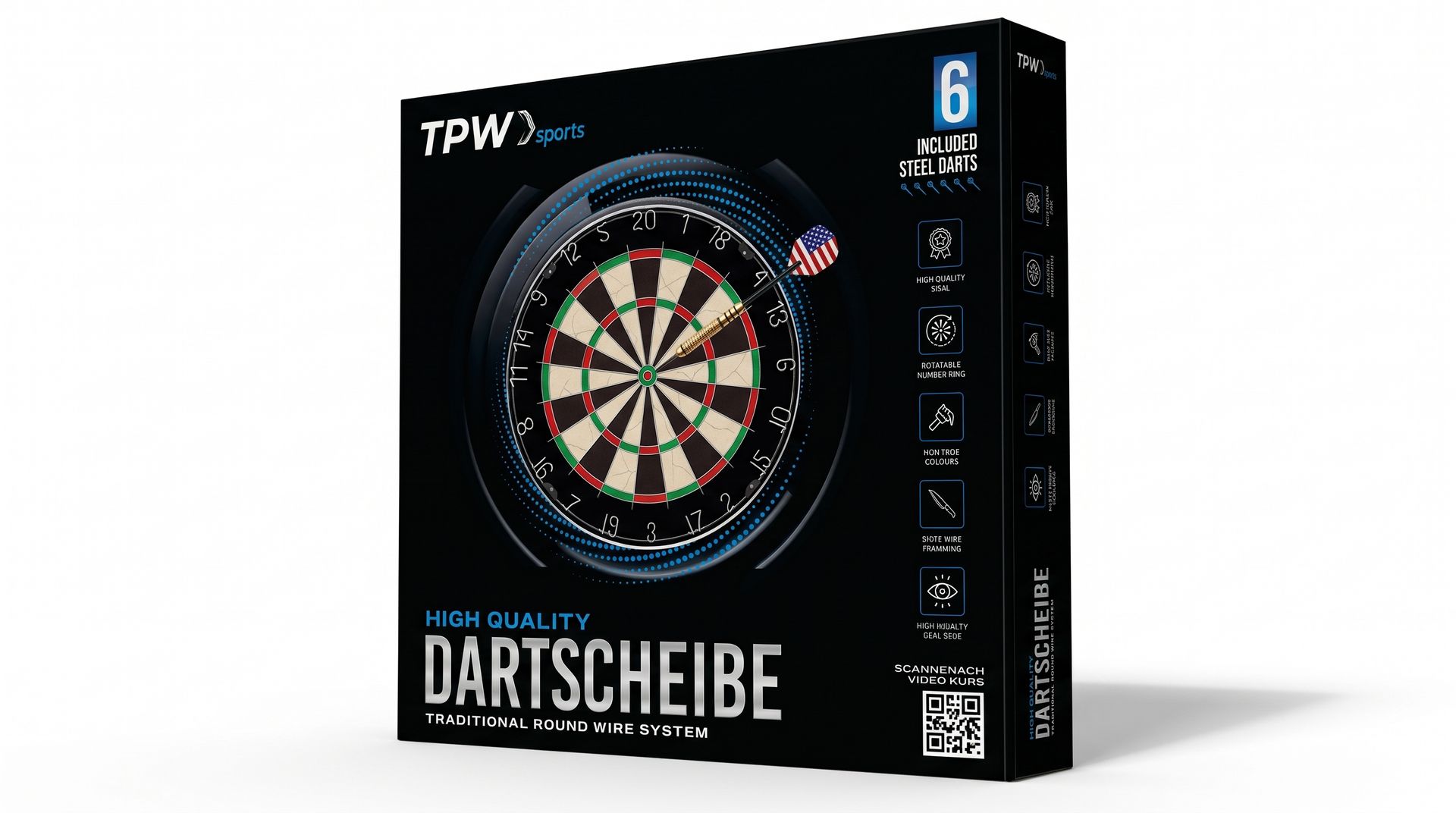
Precision is the bedrock of consistent dart play. Whether you are building a home game room, setting up a competitive league venue, or refining muscle memory for match play, a fraction of an inch in board height or throw line distance drastically alters throw trajectories and scoring accuracy. Adhering to exact dimensional standards ensures that every practice throw mirrors official tournament conditions.
Standard specifications across global competitions are strictly regulated by key governing bodies, primarily the World Darts Federation (WDF) and the Professional Darts Corporation (PDC). These organizations establish rigid manufacturing and setup tolerances to maintain fair play, uniform target ratios, and standardized equipment specs across international events.
This comprehensive guide details everything required for a flawless setup and commercial deployment:
Board Geometry & Ring Measurements: Exact wire-to-wire radii, segment dimensions, and bullseye tolerances.
Mounting Setup & Height: Precise vertical drop and diagonal measurements to set up the throw line (oche) correctly.
Room Space Requirements: Ideal physical clearance, wall protection zones, and proper lighting placement.
Retail Packaging Engineering: Structural cardboard grades, drop-test tolerances, and custom box dimensions needed to safely package and ship high-density sisal dartboards.
Standard Dartboard Specs (Steel-Tip / Sisal)
Manufactured using tightly packed natural sisal bristles, regulation steel-tip dartboards must comply with strict physical dimensions mandated by the World Darts Federation (WDF) and Professional Darts Corporation (PDC). Maintaining precise wire geometry ensures consistent target ratios across all manufacturing runs.
Overall Board Geometry
Overall Diameter: 17.75 inches (451 mm)±3 mm
The full width of the dartboard face, including the black outer catch ring and number band housing.
Board Thickness: 1.5 inches (38.1 mm)
The depth of the compressed sisal block. This thickness provides sufficient penetration depth for steel tips without striking the solid wooden backing board.
Scoring Area Diameter: 13.2 inches (335 mm)
The playable face measured from the outer wire edge of the double ring on one side across to the outer wire edge of the double ring on the opposite side.
Ring Width & Diameter Breakdown
Modern bristle boards utilize ultra-thin, blade-wire spiders embedded into the sisal to minimize bounce-outs. Precision manufacturing tolerances govern the internal radii and scoring bed widths:
Double Ring (Outer):
Segment Width: 8 mm (0.315 inches)
Radius: 170 mm (6.69 inches) from the exact center of the bullseye to the outer wire edge of the double ring.
Triple Ring (Inner):
Segment Width: 8 mm (0.315 inches)
Radius: 107 mm (4.21 inches) from the exact center of the bullseye to the outer wire edge of the triple ring.
Outer Bull (Single Bull / 25 Points):
Inner Diameter: 31.8 mm (1.25 inches) wire boundary enclosing the 25-point ring area.
Inner Bull (Double Bullseye / 50 Points):
Inner Diameter: 12.7 mm (0.50 inches) central wire circle marking the absolute center of the target face.
Steel-Tip vs. Soft-Tip (Electronic) Dartboard Dimensions
While both formats follow similar scoring rules, traditional steel-tip (bristle) boards and electronic soft-tip boards feature key dimensional, structural, and distance differences that directly impact throw accuracy and gameplay dynamics.
Steel-Tip (Bristle / Sisal)
Target Area Size: Standard 13.2 inches (335 mm) scoring diameter.
Surface & Wire Construction: Built from compressed sisal fibers paired with ultra-thin, triangular or blade-wire spiders. The narrow wire profile maximizes scoring area and deflects incoming steel points into the board to minimize bounce-outs.
Scoring Bed: Smooth, continuous fiber bed without physical perforations.
Soft-Tip (Electronic)
Target Area Size: Larger 15.5 inches (393.7 mm) active scoring diameter (commonly used in American soft-tip leagues like NDA and BullShooter).
Surface & Wire Construction: Molded plastic target segments perforated with thousands of tiny cone-shaped catch holes designed to capture flexible plastic dart tips.
Divider Thickness: Features significantly thicker plastic segment grid dividers (2mm to 3mm) compared to razor-thin steel-tip blade wires, which slightly reduces the open scoring area per bed despite the larger overall target face.
Key Spec Comparison
Parameter | Steel-Tip (Bristle / Sisal) | Soft-Tip (Electronic) |
Active Target Area Diameter | 13.2 inches (335 mm) | 15.5 inches (393.7 mm) |
Double & Triple Ring Width | 8 mm (0.315 inches) | 9.5 mm (0.375 inches) (approx. 20% wider) |
Inner Bull Diameter | 12.7 mm (0.50 inches) | 12.7 mm (0.50 inches) |
Hanging Height (Floor to Bull) | 5 ft 8 in (1.73 m) | 5 ft 8 in (1.73 m) |
Throw Line (Oche) Distance | 7 ft 9.25 in (2.37 m) | 8 ft 0 in (2.44 m) |
Max Standard Dart Weight | 50 grams (typically 21–26 g) | 20 to 25 grams (board sensor limit) |
Official Setup & Mounting Dimensions
Setting up a dartboard accurately requires precise measurement across three key vectors: vertical mounting height, horizontal throwing distance, and diagonal verification. Following official World Darts Federation (WDF) and Professional Darts Corporation (PDC) parameters ensures tournament-level accuracy in any playing environment.
Hanging Height
The vertical distance is measured strictly from the finished floor surface directly beneath the board to the exact center of the inner double bullseye.
Imperial Standard: 5 feet 8 inches (68 inches)
Metric Standard: 1.73 meters (173 cm)
Installation Tip: Measure your hanging height after laying down any carpeting, throw mats, or raised flooring tiles, as thick floor coverings will alter the true height of the bullseye.
Throw Line (Oche) Distance
The throwing distance must be measured horizontally along the floor starting from a line dropped directly down from the front face of the dartboard, not from the wall behind it. If your board protrudes 1.5 inches from the wall (plus mounting bracket offset), measure your throw line from that front surface forward.
Steel-Tip Distance: 7 feet 9.25 inches (2.37 meters /237 cm)
This is the official toe-line distance for traditional bristle boards. Players may step up to, but not over, the front edge of this line (oche).
Soft-Tip Distance: 8 feet 0 inches (2.44 meters /244 cm)
Electronic soft-tip rules extend the throwing distance by 2.75 inches to compensate for lighter dart weights and larger target segments.
Diagonal Measurement (Bullseye to Oche)
The diagonal check is the ultimate verification tool. It runs directly from the center of the double bullseye to the back edge of the throw line (oche) at floor level. Using a tape measure along this hypotenuse ensures your vertical height and horizontal distance are perfectly square in a single step.
Steel-Tip Diagonal: 9 feet 7.5 inches (2.93 meters /293 cm)
Verification Formula: Using the Pythagorean theorem (A^2+B^2=C^2):
(Height) ^2 (68^2 )+(Distance)^2 (93.25 ^2)=4624+8695.56=13319.56√13319.56≈115.41 inches (9 ft 7.41 in ≈9 ft 7.5 in)
Why Installers Use This Trick
Measuring horizontally along the floor is notoriously prone to error because your dartboard sticks out $1.5\text{ inches}$ (plus bracket depth) from the wall—meaning you can't just hook a tape measure onto the baseboard. By anchoring your tape measure directly into the center of the bullseye and pulling it taut down to the floor at 9 (ft) 7.5(in), you simultaneously confirm that your board height is level, your floor isn't sloped, and your throw line is exact.
Dartboard Packaging & Retail Box Specifications
Packaging a regulation sisal dartboard presents distinct structural engineering challenges. Because bristle boards consist of highly compressed natural fibers bound under extreme pressure, they represent a heavy, high-density payload that demands robust corrugated packaging to prevent transit damage and retail box deformation.
Uncompressed Weight & Load Capacity
Heavy Payload: A standard bristle dartboard weighs between 11 to 12.5 lbs (5 to 5.7 kg) due to its dense, self-healing sisal fiber construction and heavy wooden backing.
Load Requirement: This concentrated weight creates significant dynamic forces during freight transit. Standard lightweight folding cartons will tear or burst; heavy-duty corrugated board is mandatory to maintain structural integrity under stack pressures.
Box Inner Dimensions & Tolerances
Standard Retail Box Format: 18.5×18.5×2.25 inches (470×470×57 mm).
Clearance Buffer: Because a standard regulation dartboard measures 17.75 inches (451 mm) in diameter and 1.5 inches (38.1 mm) in thickness, this box size provides an essential 0.375 inch (9.5 mm) internal buffer around the perimeter. This extra clearance accommodates structural protective inserts, mounting brackets, scorecards, and hanging hardware without causing box distortion.
Structural Substrate & Fluting
Corrugated Grade: B-flute or E/B double-wall corrugated cardboard with a test rating or 32 ECT (Edge Crush Test) minimum. B-flute provides excellent crush resistance and puncture protection against high-density weight, while preventing side-wall crushing and corner blowouts when stacked in warehouses.
Retail Printing & Finish: Premium Litho-laminated C1S (Coated 1 Side) paperboard mounted directly onto the corrugated fluting. Applied with glossy or soft-touch matte lamination, this delivers vibrant, high-impact retail shelf graphics while shielding the printed surface from scuffing and moisture during handling.
Browse other formats: Custom Golf Ball Boxes, Toy Boxes or Retail Boxes.
Internal Protective Inserts
Structural Stability: Custom thermoformed plastic trays or E-flute die-cut corrugated corner guards lock the board centrally inside the carton.
Surface & Accessory Protection: These inserts suspend the face of the board away from the carton walls, preventing the sharp steel number band and sisal face from scratching during movement. Dedicated cavities securely hold hardware kits, hanging brackets, and extra steel-tip darts to eliminate rattle and inner box impact.
Room Requirements & Safety Clearances
Creating a safe, functional dart lane requires adequate physical space, wall safeguards, and clear lighting. Proper layout design protects home interiors from stray darts, provides clearance for players, and ensures consistent visual clarity.
Minimum Space Needed
Recommended Lane Width: 5 feet (1.5 meters)
Provides a comfortable 2.5-foot buffer on either side of the bullseye centerline, allowing room for a natural stance and preventing throwers from feeling cramped against side walls or furniture.
Recommended Lane Length: 11 feet (3.35 meters)
Extends beyond the 7 ft 9.25 in throw line to accommodate the player’s follow-through, stepping room, and safe movement for scorekeepers or spectators standing behind the thrower.
Wall Protection & Surround Clearance
High-Density Foam Surrounds: A standard catch ring adds a 5.25 to 6-inch (13.3 to 15 cm) protective border around the board's outer edge, catching errant throws that miss the number band.
Total Coverage Radius: High-density foam surrounds and wooden dartboard cabinets create an overall 24 to 30-inch (61 to 76 cm) protection radius measured from the bullseye out, shielding drywall and brick from deep punctures.
Lighting Positioning
Shadowless LED Surround Lights: Modern 360-degree LED ring lights (such as the Target Corona or Winmau Polaris) mount directly to the board frame, casting uniform, shadow-free illumination across all scoring beds.
Overhead Spotlight Positioning: If using traditional spotlights, position them 4 to 5 feet (1.2 to 1.5 meters) out from the wall at a 45-degree downward angle. This angle illuminates the scoring face clearly without creating harsh wire shadows or causing glare in the thrower's direct line of sight.
Key Takeaways: Standard Dartboard Specs & Packaging
Regulation Precision Matters: Standard steel-tip dartboards require an overall diameter of 17.75 inches (451 mm), a thickness of 1.5 inches (38.1 mm), and a scoring area diameter of 13.2 inches (335 mm) to meet official WDF and PDC tournament standards.
Exact Mounting Geometry: Hanging height must measure exactly 5 feet 8 inches (1.73 meters) from the floor to the double bullseye, with a horizontal throwing distance of 7 feet 9.25 inches (2.37 meters) and a diagonal check of 9 feet 7.5 inches (2.93 meters).
Steel-Tip vs. Soft-Tip Differences: Electronic soft-tip boards feature a larger active target area (15.5 inches) and require an extended 8-foot throwing line to balance gameplay against steel-tip standards.
High-Density Packaging Requirements: Weighing between 11 to 12.5 lbs (5 to 5.7 kg), compressed sisal dartboards demand heavy-duty B-flute or double-wall corrugated cardboard (32 ECT minimum) to prevent corner blowouts and side-wall crushing.
Optimized Box Tolerances: Standard retail boxes require an internal footprint of 18.5×18.5×2.25 inches (470×470×57 mm) to provide a 0.375 inch buffer for protective inserts, mounting brackets, and extra accessories.
Safety & Room Clearance: Safe play environments mandate a 5-foot lane width, 11-foot lane length, high-density wall surrounds (24 to 30-inch radius), and 360-degree LED lighting to eliminate target shadows.
Ensure your sports equipment reaches retail shelves in flawless, tournament-ready condition. Partner with The Packaging World for custom, heavy-duty corrugated shipping solutions engineered for maximum product protection and high-impact retail presence.
Need custom packaging for your product?
Get pricing, samples, and expert advice — no commitment required.
Topics