
Spice Label Guidelines: FDA Regulations, Design & Material Selection
Designing spice labels for the US market requires balancing strict FDA mandates with high-impact retail branding. This comprehensive guide details 21 CFR requirements—including Statement of Identity, FALCPA/FASTER Act allergen rules, and PDP math, while outlining visual hierarchy strategies and material choices built to survive demanding kitchen environments.

Awais M · Custom Packaging Specialist
Awais M helps small and mid-sized brands get custom packaging right — the box style, the material, the print finish, and the order quantity that actually fits the budget.
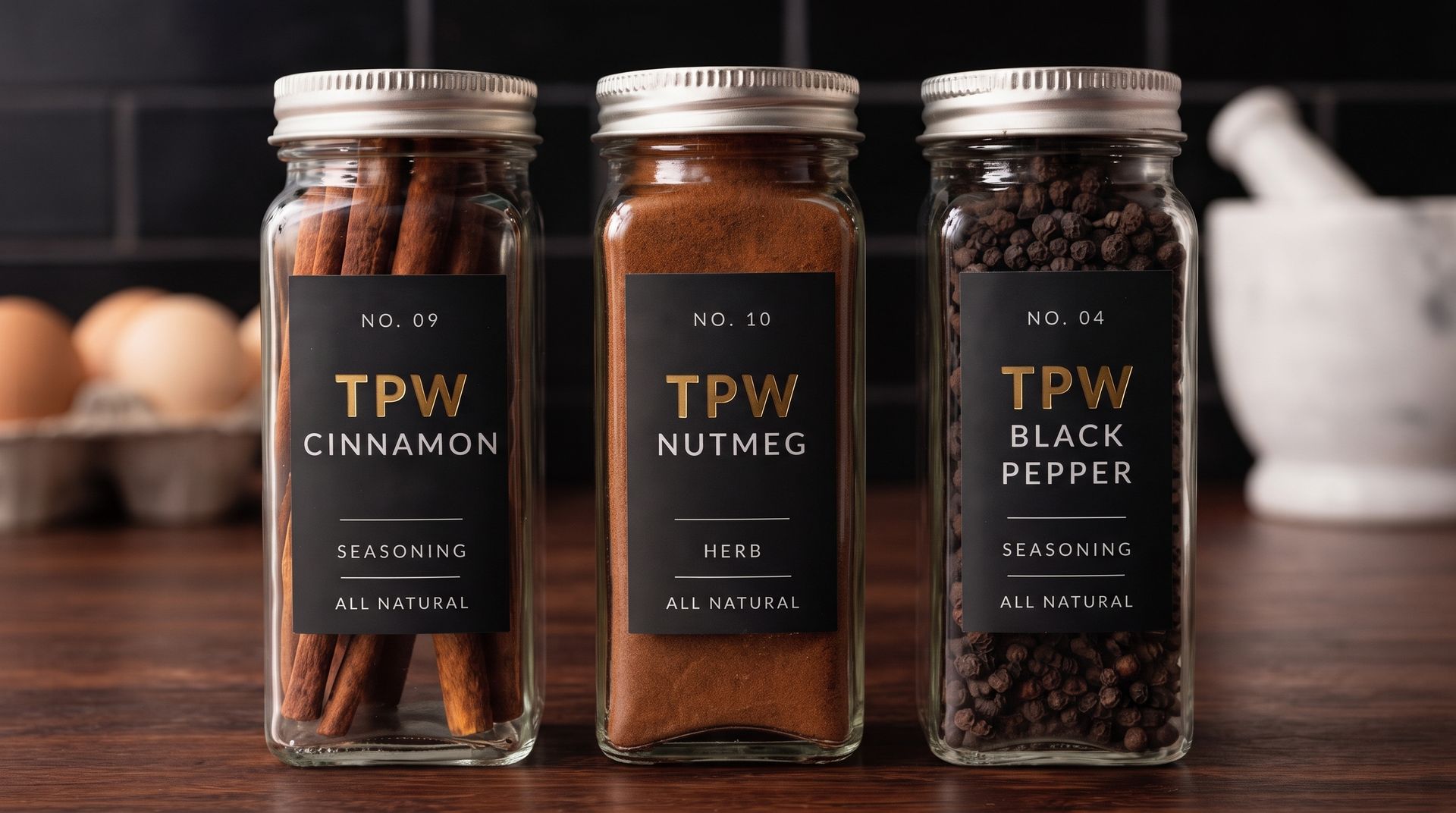
For specialty spice vendors and commercial food manufacturers alike, a label is far more than a decorative sticker; it is a critical legal document, a protective barrier, and a powerful sales tool. Under strict FDA mandates, clear and compliant labeling ensures product safety, transparent allergen communication, and immediate consumer trust.
Beyond compliance, high-performance label engineering protects visual aesthetics from harsh kitchen conditions, such as steam, oils, and frequent handling, preventing peeling or smudging that can undermine a brand's premium image.
This technical guide provides a step-by-step walkthrough for designing, engineering, and producing high-impact spice box labeling for the US market. We will cover essential FDA regulatory standards under 21 CFR, strategies for establishing a clear visual hierarchy on small-format containers, and material selections that ensure long-lasting durability.
By aligning legal compliance with strategic label engineering, spice brands can build lasting consumer loyalty, protect product integrity, and maximize retail conversion on crowded store shelves.
Mandatory FDA Regulatory & Compliance Requirements (US Standards)
Compliance with Title 21 of the Code of Federal Regulations (21 CFR) is non-negotiable for food products sold in the United States. Under FDA guidelines, spice labels must feature five core regulatory elements divided between the Principal Display Panel (PDP) and the Information Panel to prevent product misbranding for food packaging.
A. Statement of Identity (21 CFR 101.3)
Common or Usual Name: The PDP must prominently display the standard, common name of the spice rather than a vague brand name. Valid statements include Whole Black Peppercorns, Ground Organic Cinnamon, or Smoked Paprika Blend.
Form Declaration: If the spice comes in multiple forms (e.g., whole, cracked, ground, or rubbed), the specific physical form must be included as part of the identity statement unless visually obvious through clear packaging.
Prominence: The text must appear in bold, direct contrast to the background, and in a size reasonably related to the largest printed matter on the front panel.
B. Ingredient List & Major Food Allergens (FALCPA / FASTER Act)
Order of Predominance: Single-ingredient spices do not require a separate ingredient list if the Statement of Identity clearly names the ingredient. For spice blends or rubs, all ingredients must be listed in descending order of predominance by weight.
Declaring Spices & Colors: Under 21 CFR 101.22, general sub-ingredients can often be declared as "spices," but color-imparting spices (such as paprika, turmeric, or saffron) must be explicitly declared by their specific name.
The 9 Major US Food Allergens: Under the Food Allergen Labeling and Consumer Protection Act (FALCPA) and the FASTER Act, manufacturers must explicitly declare major allergens: Milk, Eggs, Fish, Crustacean Shellfish, Tree Nuts, Peanuts, Wheat, Soy, and Sesame.
Declaration Format: Allergens must be declared either in parentheses within the ingredient list—e.g., Ingredients: Garlic, Salt, Sesame Seeds (sesame), or in a dedicated "Contains" statement immediately adjacent to or below the ingredient list in equal font size (e.g., CONTAINS: SESAME).
C. Net Quantity of Contents (21 CFR 101.105)
Dual Unit Declaration: The label must declare the net quantity of food in both US Customary units (avoirdupois ounces or pounds) and Metric units (grams or kilograms). Example: NET WT 4 OZ (113g).
PDP Placement: The net quantity statement must be positioned as a distinct line within the bottom 30% of the Principal Display Panel, running parallel to the base of the container.
Type Size Proportions: Font size must scale with the area of the PDP (e.g., minimum 1/16-inch height for panels 5 sq. inches or less; 1/8-inch for panels between 5 and 25 sq. inches).
D. Nutrition Facts Panel (21 CFR 101.9)
Standard Requirement: Packaged food sold to US consumers generally requires an updated FDA Nutrition Facts Panel displaying calories, fats, sodium, total carbohydrates, sugars, added sugars, protein, Vitamin D, calcium, iron, and potassium.
Small-Amount / Zero-Nutrient Exemption: Under 21 CFR 101.9(j)(4), single-ingredient pure spices (like black pepper or oregano) that contain insignificant amounts of all mandatory nutrients (less than 5 calories, 0g fat, 0g sugar, etc.) are exempt from carrying a Nutrition Facts Panel.
Small Business Exemptions: Under 21 CFR 101.9(j)(1) and 101.9(j)(18), low-volume manufacturers employing fewer than 100 full-time workers and selling fewer than 100,000 units annually in the US can apply for an exemption from nutrition labeling.
Loss of Exemption: If a spice label makes any nutrient content claim (e.g., "Sodium-Free"), health claim, or structure/function claim, all nutrition labeling exemptions are automatically revoked.
E. Manufacturer / Distributor Statement (21 CFR 101.5)
Business Information: The label must state the name and place of business (city, state, and zip code) of the manufacturer, packer, or distributor.
Qualifying Phrases: If the company named on the label is not the actual party who manufactured the product, the name must be preceded by a qualifying phrase explaining the relationship, such as "Manufactured for [Company Name]" or "Distributed by [Company Name]".
Placement: This statement must be printed conspicuously on either the Principal Display Panel or the Information Panel in a print size no smaller than inch in height.
Structural Design & Visual Hierarchy
PDP & Labeling Area Rules: The Principal Display Panel (PDP) is the front area most likely displayed on store shelves. Required font sizes (especially for Net Quantity) scale directly with the container's surface area. For standard cylindrical jars, the PDP area is calculated as the total height multiplied by the circumference (0.40 x Height x Circumference).
Typography & Legibility: Due to limited surface area on 2 oz to 8 oz spice jars, typography must strictly prioritize clarity. Essential mandatory text, including ingredient lists and manufacturer details, must adhere to the FDA's minimum 1/16-inch type height (based on the lowercase letter "o") to remain fully legible.
Color Coding by Spice Category: Utilizing structured color palettes helps consumers instantly identify spice sub-categories on retail displays. Assigning consistent visual cues, such as fresh greens for leafy herbs, vivid reds/oranges for chilis and peppers, and deep earthy browns for baking spices, improves shopability and creates cohesive brand architecture across product lines.
Material Engineering & Kitchen Durability
Kitchen Stressors: Spice labels endure constant exposure to harsh environmental conditions, including airborne grease, direct oil splatters, cooking steam, elevated stove-top temperatures, and frequent friction from wet or greasy hands.
Substrate Selection: While estate paper stocks offer an artisanal look, heavy-duty synthetic films, specifically Biaxially Oriented Polypropylene (BOPP) and Polyethylene (PE), provide superior water and oil resistance. Pair these synthetic substrates with a protective matte or gloss lamination to lock in inks and prevent surface scuffing or chemical breakdown.
Adhesive Performance: Utilizing high-tack, emulsion-acrylic permanent adhesives ensures a lasting bond on glass, plastic, or tin surfaces. This robust adhesive backing prevents edge curling, corner flagging, and label migration caused by ambient kitchen humidity and temperature fluctuations.
Quality Assurance Checklist Before Production
FDA Compliance Verification: Double-check all mandatory elements against 21 CFR standards. Confirm the Statement of Identity is prominent on the PDP, ingredients are ordered by weight, allergens are explicitly declared under FALCPA/FASTER Act rules, and manufacturer details include a full mailing address.
UPC Barcode Integrity: Verify that UPC-A or EAN barcodes meet ANSI/ISO scannability standards for US retail POS systems. Place barcodes on a flat, non-curved surface or orient vertical bar lines parallel to the jar's curve to prevent scanner distortion, ensuring a high-contrast white background box with adequate quiet zones.
Physical Container Fit Testing: Conduct physical wrap-around trials on production-line containers (such as 4 oz French square glass jars, 8 oz round shakers, or metal tin canisters). Verify overlap seams, check that corner radii prevent flagging, and ensure the die-cut dimensions leave appropriate top and bottom margins without obstructing pour spouts or caps.
Key Takeaways
FDA Compliance Is Mandatory: US spice labels must strictly follow 21 CFR rules, requiring a prominent Statement of Identity, accurate dual-unit Net Quantity, and complete manufacturer contact details.
Allergens Must Be Explicit: Under FALCPA and the FASTER Act, major US allergens, including sesame, wheat, and soy, must be declared in plain English in or directly adjacent to the ingredient list.
Strict -Inch Minimum Typography: All required regulatory statements on small 2 oz to 8 oz spice jars must meet the FDA -inch font height rule to guarantee legibility and avoid misbranding penalties.
BOPP Synthetics Outperform Paper: Flexible Biaxially Oriented Polypropylene (BOPP) films paired with protective laminations resist oil splatters, steam, heat, and grease far better than paper stocks.
High-Tack Adhesives Prevent Peeling: Emulsion-acrylic permanent adhesives ensure long-term label adhesion on glass, plastic, and metal shakers, preventing corner flagging under kitchen humidity.
Pre-Production Testing Avoids Delays: Pre-flight checks should always include ANSI barcode scannability verification, full FDA statement proofing, and physical container fit tests on target jar sizes.
Partner with The Packaging World to engineer custom spice labels tailored to your exact brand specifications and container shapes. From oil-resistant BOPP films and protective laminations to precision die-cutting for French square jars, round shakers, and tin canisters, we provide low MOQs, industry-leading print clarity, and fast turnarounds.
Contact our packaging specialists today to request custom sample kits or start your next spice labeling project!
Need custom packaging for your product?
Get pricing, samples, and expert advice — no commitment required.
Topics
Industries