
How Many Face Cards Are in a Deck? Breakdown, Math & History
Settling a card table debate? A standard 52-card deck contains exactly 12 face cards: the Jack, Queen, and King across all four suits. This complete breakdown explores suit distribution, drawing probabilities, historical origins, unique design quirks like "One-Eyed Jacks," and common card game rules.

Awais M · Custom Packaging Specialist
Awais M helps small and mid-sized brands get custom packaging right — the box style, the material, the print finish, and the order quantity that actually fits the budget.
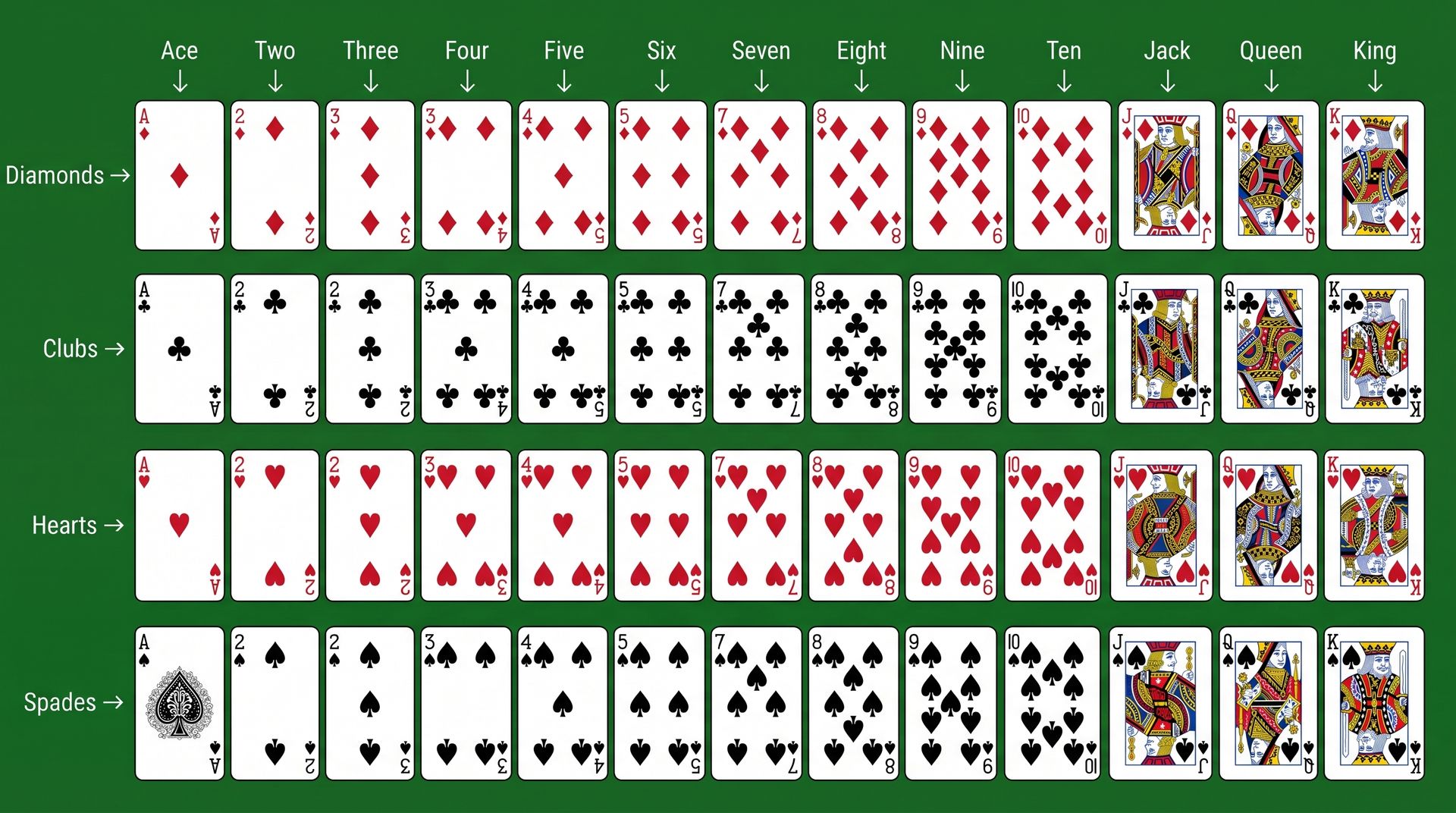
Few things derail a game night faster than a heated debate over basic rules. Mid-game, as the stakes rise in a hand of Blackjack or Rummy, someone inevitably poses the question: does an Ace count as a face card? What about a Joker, or even a numerical 10? Settling these table arguments requires a clear understanding of standard card classifications.
To put the debate to rest immediately: there are exactly 12 face cards in a standard 52-card deck. These consist strictly of the Jack, Queen, and King across each of the four traditional suits. Neither Aces nor Jokers carry the required portrait illustration to qualify as face cards, regardless of how much point value they hold in specific games.
In this guide, we will break down everything you need to know about face cards. We’ll explore their exact suit distributions, clear up common terminology, uncover the fascinating historical origins behind their royal portraits, examine unique design quirks like "One-Eyed Jacks," calculate drawing probabilities, and look at how these 12 cards drive strategy in popular games.
What Is a Face Card?
A face card is any playing card in a standard Western deck that features an illustration of a human figure rather than numerical symbols (pips).
The Core Trio: The category consists strictly of three royal ranks: the Jack, the Queen, and the King.
Interchangeable Terminology: These 12 cards are often called court cards (referring to the royal court figures depicted) or picture cards (referring to the full-body portrait artwork). All three terms refer to the exact same set of cards.
What Is NOT a Face Card:
Aces: Although labeled with an "A" and often holding the highest rank in games, an Ace features a single suit symbol (pip) and no portrait.
Jokers: While often illustrated with a jester figure, Jokers are supplementary wild cards and are not part of the core 52-card court hierarchy.
10s: Despite sharing a 10-point value with face cards in games like Blackjack, a 10 card features numerical pips and no human illustration.
How the 12 Face Cards Break Down by Suit
A standard 52-card deck is split evenly into four suits of 13 cards each. Every suit contains exactly three face cards:
Spades: Jack of Spades, Queen of Spades, King of Spades
Hearts: Jack of Hearts, Queen of Hearts, King of Hearts
Diamonds: Jack of Diamonds, Queen of Diamonds, King of Diamonds
Clubs: Jack of Clubs, Queen of Clubs, King of Clubs
The Math Behind the Deck
Multiplying the 4 suits by the 3 face cards per suit gives a total of 12 face cards in every standard deck.
Out of 52 total cards, these 12 face cards represent exactly 23.08% of the entire deck.
Special Anatomy & Design Quirks of Face Cards
Beyond their point values, standard face cards feature unique visual details and historical quirks that set specific cards apart:
One-Eyed Jacks: While most court cards are drawn facing forward, the Jack of Spades and Jack of Hearts are rendered in side profile, showing only one eye. Games like Sequence or wild-card variants of Rummy often assign these two specific cards unique abilities, such as removing opponent pieces or acting as wild cards.
The Suicide King: The King of Hearts is famous for appearing to thrust a sword directly into his own head. This was not originally intended to portray suicide; rather, poor woodblock copying over centuries degraded the original artwork, which originally depicted the king raising a broadaxe above his head.
The Profile King: The King of Diamonds is the only king rendered in side profile. Unlike the other three kings who wield broadswords, he carries a battleaxe tucked behind his shoulder, earning him the nickname "the king with an axe."
Two-Headed (Symmetrical) Design: Prior to the 19th century, face cards featured full-length portraits. Printing press makers introduced double-ended (reversible) court cards so players could read their hand from either direction without rotating cards right-side up and tipping off opponents.
A Brief History of Face Cards
The visual design and titles of modern court cards are the result of centuries of global evolution and historical influence:
Origins: Playing cards originated in 9th-century Tang Dynasty China, spreading westward through Mamluk Egypt and Persia before arriving in Western Europe during the late 14th century. European card makers adapted these early suits by introducing illustrated royal figures to represent court hierarchy.
Royal Figures: During the 16th century, French card makers standardized court portraits by linking each face card to legendary historical, biblical, or mythological figures:
Kings: Charlemagne (Hearts), Julius Caesar (Diamonds), King David (Spades), and Alexander the Great (Clubs).
Queens: Pallas/Athena (Spades), Judith (Hearts), Rachel (Diamonds), and Argine (Clubs).
From Knave to Jack: The lowest court card was originally called the Knave (meaning a male servant or royal attendant). In the mid-19th century, when card makers added corner indices ("K" for King), using "Kn" for Knave caused frequent confusion. Card printers officially adopted the popular slang term Jack, allowing for a distinct "J" corner mark.
Face Cards vs. Number Cards: Direct Comparison
While both categories make up the core structure of a standard 52-card deck, their visual designs, total counts, and roles in gameplay differ significantly.
Visual & Structural Differences
Face Cards: Feature detailed, dual-ended portrait illustrations representing royal court hierarchy (Jack, Queen, King). They rely on named ranks rather than counting pips to establish identity.
Number Cards: Feature numerical suit symbols (pips) printed across the face of the card corresponding directly to its rank ( through ).
Aces: Sit in a unique structural category. Visually, an Ace is a pip card (featuring a single, oversized center suit symbol and no portrait), though it holds high-ranking strategic value alongside court cards in most games.
Feature Comparison
Feature | Face Cards | Number Cards | Aces |
Visual Design | Full portrait illustration | Numerical pip symbols (2-10) | Single center pip symbol |
Cards Included | Jack, Queen, King | Ace | |
Total in Deck | 12 cards | 36 cards | 4 cards |
Deck Proportion | 23.08% | 69.23% | 7.69% |
Blackjack Value | 10 points each | Face value (2-10 points ) | or 11 points |
Poker Role | High-card value & strong melds | Low/mid-rank connectors & sets | Highest high-card / Low-end straight connector |
Single-Card Draw Odds | 3 in 13 ≈ (23.08%) | 9 in 13 (≈69.23%) | 1 in 13 (≈7.69%) |
Common Misconceptions About Face Cards
Despite the simplicity of a 52-card deck, several long-standing myths confuse players at the card table:
Myth 1: "There are 16 face cards in a deck."
The Reality: This confusion usually happens because players group Aces in with Jacks, Queens, and Kings due to their high value. Aces do not carry human portraits, so the actual total remains strictly 12.
Myth 2: "Jokers count as face cards."
The Reality: Although Jokers feature full illustrations of jesters, they are supplemental cards. They sit outside the traditional court hierarchy and are excluded from the standard 52-card count.
Myth 3: "Any card marked with a letter is a face card."
The Reality: The corner index 'A' stands for Ace, but because an Ace displays a central pip rather than a court portrait, it is classified as a pip card rather than a picture card.
Myth 4: "All face cards face forward in the same direction."
The Reality: Stances vary by rank and suit. The Jack of Spades, Jack of Hearts, and King of Diamonds are rendered in side profile, while the remaining nine court figures face forward or off-center.
Face Cards in Popular Games
Beyond their distinct visual design, face cards drive core mechanics and strategic decisions across classic casino and table games:
Blackjack: All 12 face cards carry a fixed value of 10 points. Pairing any Jack, Queen, or King with an Ace on the initial deal forms a "Natural 21" (Blackjack), yielding an instant payout (typically 3:2). Because face cards make up 23.08% of the deck, tracking high-value cards is critical for card counting and basic strategy decisions like splitting or doubling down.
Poker: Face cards dominate high-card strength and form key components of elite hands, including Straights, Full Houses, and the elusive Royal Flush (10, Jack, Queen, King, Ace of the same suit). Additionally, high face cards often act as decisive "kickers" to break ties when two players hold identical pairs or two-pair combinations.
Rummy & Gin Rummy: Face cards represent a high-risk, high-reward dynamic. While they can be melded into three- or four-of-a-kind sets or suit runs, holding unmatched court cards at the end of a round carries a steep 10-point penalty per card. Experienced players often discard unmatched face cards early to minimize deadwood points.
Get Custom Playing Cards or Card Packaging?
Whether you are a table game publisher, promotional agency, corporate event planner, or boutique retailer, high-impact presentation is just as vital as the cards inside the box. We specialize in premium, custom packaging solutions that protect, present, and showcase your brand across retail shelves and e-commerce storefronts. From rigid tuck boxes and foil-stamped playing card decks to luxury gift sets and branded merchandise packaging, we bring your vision to life.
Need custom packaging for your product?
Get pricing, samples, and expert advice — no commitment required.
Topics
Industries