
Custom Ring Box Inserts: Single Slit vs. Split Foam
Selecting the right ring box insert is crucial for presenting high-value fine jewelry. This technical guide compares classic single-slit inserts with two-piece interlocking foam systems, evaluating lateral tension, band compatibility, and production efficiency, helping independent jewelers and bridal brands choose the ideal insert architecture to keep gemstone settings upright, secure, and impeccably displayed.

Awais M · Custom Packaging Specialist
Awais M helps small and mid-sized brands get custom packaging right — the box style, the material, the print finish, and the order quantity that actually fits the budget.
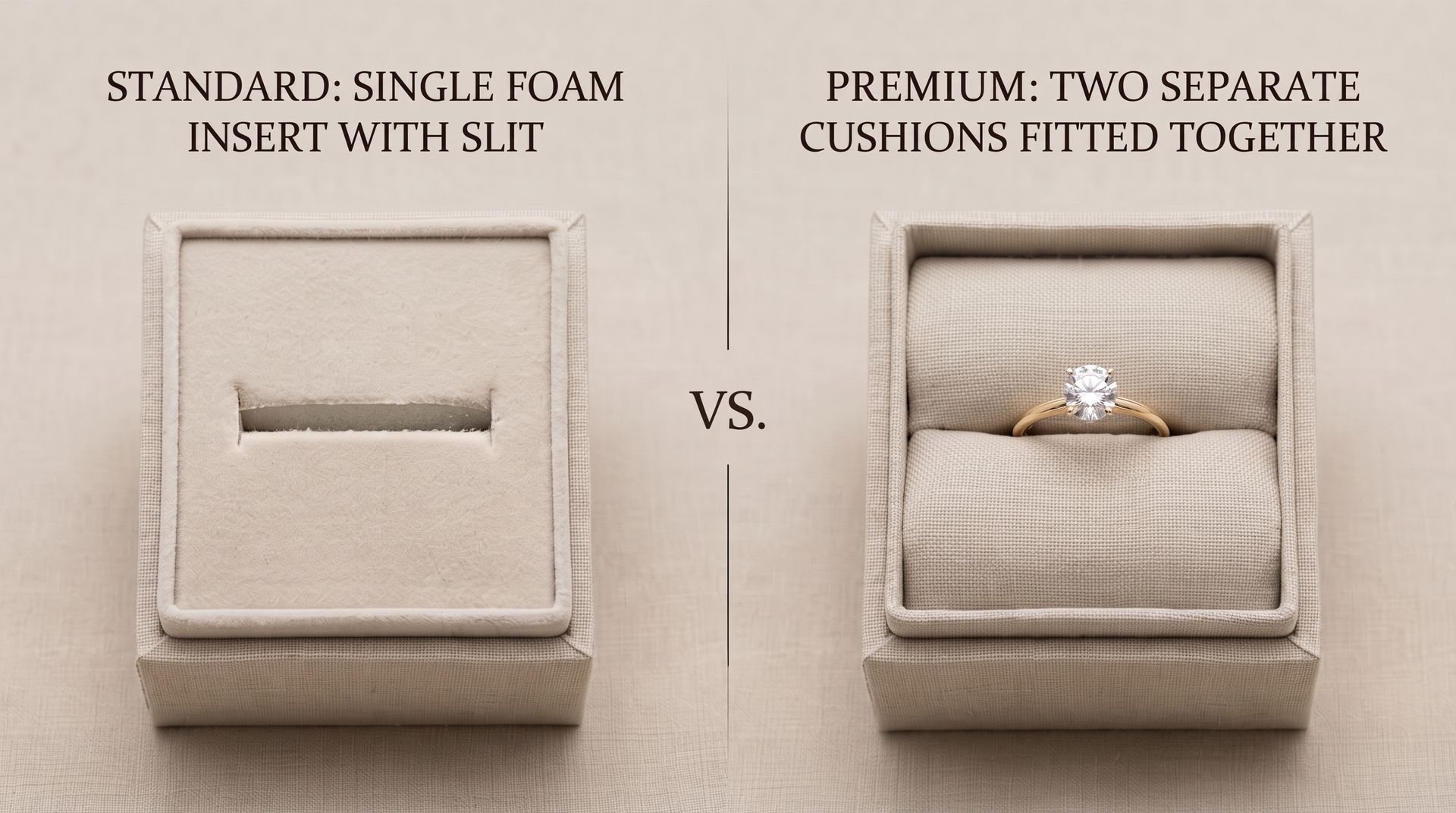
When presenting a high-value solitaire, a complex bridal set, or a bespoke gemstone ring, the interior insert plays a critical role in defining the customer's unboxing experience.
To meet the high standards of fine jewelry retail, a ring box insert must fulfill three core requirements: ensure total ring stability during transport, deliver a flawless upright presentation upon opening, and offer long-term durability without insert sagging or fabric fraying. If an insert fails, the ring risks tilting sideways, falling flat during transit, or suffering scuffs, instantly diminishing the perceived value of the piece inside.
This brings packaging designers and jewelers to a central technical choice: deciding between a streamlined single insert with a central slit versus a two-piece interlocking insert system. Each design offers distinct structural advantages, friction dynamics, and aesthetic qualities depending on the ring style, band width, and price point. Understanding these differences allows jewelry brands to select the ideal insert architecture to showcase their collections securely and elegantly.
Understanding the Single Insert with a Slit Ring Box
Structure & Mechanics
The single-slit insert is the classic standard of jewelry packaging. It is engineered from a solid, continuous block of high-density EVA foam or rigid wrapped paperboard, precision die-cut or laser-cut with a single horizontal slot through the center. To create a soft, protective cushion, the core material is wrapped in premium plush velvet, suede, or microfiber fabric, with the fabric tucked cleanly into the central cut to create a cushioned friction channel.
Pros & Advantages
Production & Cost Efficiency: Because it utilizes a single molded or die-cut core, manufacturing involves fewer production steps and lower tooling costs. This streamlined fabrication allows for faster assembly times and exceptional cost-efficiency during high-volume wholesale runs.
Clean, Minimalist Aesthetic: With no visible seams, joins, or dividing lines across the floor of the box, the single insert creates an uninterrupted, continuous velvet bed. This seamless backdrop keeps the viewer’s visual attention focused entirely on the brilliance of the center gemstone.
Universal Band Compatibility: The central slit relies on natural foam compression to create a snug friction grip around delicate ring shanks, making it an ideal choice for standard solitaire engagement rings, thin micro-pavé bands, and lightweight fashion rings.
Cons & Limitations
Slit Stretching & Wear: Over time, inserting wide ring shanks or repeatedly removing the ring can permanently stretch the internal foam core and loosen the fabric lining. As the slit widens, thinner bands lose their friction grip and may begin to lean or wobble.
Limited Deep-Pavé & Wide Band Support: Exceptionally thick men’s wedding bands, wide signet rings, or low-set basket mountings can struggle to seat fully into a standard single slit. Forcing wider shanks into a tight slot often puckers the surrounding fabric or deforms the flat surface of the insert.
Understanding Interlocking / Split Inserts Ring Boxes
Structure & Mechanics
The two-piece interlocking insert system, often referred to as a split insert or dual-pad architecture, is engineered using two separate foam or wrapped paperboard blocks placed directly side-by-side. Rather than cutting a slot into a single block, the natural junction line between these two independent pads forms a structural spring groove. Each pad is wrapped individually in velvet, suede, or silk fabric before being fitted into the box cavity, where side-wall friction from the rigid box frame or base adhesive holds the two halves securely in place.
Pros & Advantages
Superior Ring Stabilization: Because the two pads act as independent cushions, they exert uniform lateral compression against both sides of the ring shank. This equalized pressure locks the ring in place, preventing top-heavy diamond mountings from tilting sideways during handling or transit.
Accommodates Variable Band Widths: The split seam naturally adjusts to different shank dimensions. It expands to fit thick men’s wedding bands, intricate antique mountings, or double-ring bridal sets without permanently stretching the insert or wrinkling the surrounding fabric.
Enhanced Luxury Perception: The multi-component construction gives the interior of the box a tailored, bespoke feel. This architectural finish mirrors custom jewelry showcases, signaling high-end craftsmanship to the buyer before they even view the ring.
Cons & Limitations
Higher Production Complexity: Manufacturing split inserts demands strict tolerance control. If the dimensions of either pad vary by even a fraction of a millimeter, the center seam may appear uneven, cocked, or gapped, ruining the symmetrical look.
Increased Unit Cost: Wrapping two separate insert components and hand-assembling them into a tight-fitting rigid box increases labor hours and raw material usage, leading to higher unit costs and longer production lead times.
Head-to-Head Comparison: One Slit vs. Two-Piece Inserts
Feature / Metric | Single Insert with Slit | Split Insert | Winner / Best Choice |
Manufacturing Cost | Economical & budget-friendly | Higher production & assembly costs | Single Slit Insert |
Ring Security (Heavy/Wide Bands) | Moderate (Can stretch over time) | Maximum (Flexible side pressure) | Split Insert |
Visual Elegance & Seams | Seamless, continuous surface | Visible center dividing line | Single Slit Insert |
Durability Against Repeated Use | Slit can widen over time | Maintains tension across usage | Split Insert |
Ideal Application | Single solitaire rings & thin bands | Bridal sets, wide bands, luxury lines | Depends on Ring Type |
Key Technical Considerations for Jewelers
Gemstone Clearance & Headspace
High-carat center stones, cathedral settings, and elevated peg heads add significant vertical height to a ring.
Vertical Clearance Parameter: Maintain a minimum of 5mm to 8mm of clear vertical headspace between the table facet of the diamond or gemstone and the plush underside of the padded lid when closed.
Preventing Setting Pressure & Scratches: Insufficient headspace causes the top lid cushion to press directly against the crown of the gemstone or gold prongs, which can scuff delicate metal finishes, loosen prongs, or prevent the rigid box lid from flush closing.
Velvet Wrap Quality & Fabric Stretch
The fabric wrap serves as both a protective barrier and the primary visual backdrop for the jewelry piece.
Selecting High-Stretch Micro-Velvet: Use multi-directional stretch micro-velvet or plush suede with a reinforced knitted backing. Cheap, non-stretch synthetic velvets lack flexibility, leading to tearing, fraying, or white thread exposure along the tight stress points of a central slit or split seam.
Friction & Abrasion Protection: Premium velvet features dense, short-pile fibers that resist crushing under heavy band pressure while preventing microscopic scratches on polished platinum, gold, or silver shanks.
Box Frame Tolerance & Sidewall Compression
The performance of both single-slit and split inserts depends entirely on the precision of the outer rigid box walls.
Eliminating Interior Gaps: The interior cavity dimensions of the grayboard frame must maintain a strict 0.2mm manufacturing tolerance.
Preventing Insert Separation: If the box frame is slightly oversized, split inserts will spread apart, losing their lateral spring tension and causing the ring to drop into the gap. Conversely, an oversized single-slit insert will bow or cup upward, creating an uneven surface across the velvet bed.
See our other formats of jewelry boxes: gemstone packaging, jewelry bags, bracelet boxes, or rigid boxes.
Key Takeaways
Match Insert Architecture to Ring Style: Opt for a classic single-slit insert for delicate solitaire rings and thin bands; choose a two-piece split insert for wide men’s bands, heavy mountings, and bridal sets.
Balance Aesthetics with Production Budget: Single-slit inserts deliver a seamless, cost-effective velvet bed ideal for high-volume production, whereas two-piece inserts offer a tailored, furniture-style finish at a higher unit cost.
Prevent Slit Stretch & Ring Tilt: Dual-piece interlocking inserts eliminate long-term slit stretching by using lateral spring pressure from two independent pads to keep top-heavy diamond settings strictly upright.
Maintain Strict Gemstone Headspace: Ensure at least 5mm to 8mm of vertical clearance between the top facet of the center stone and the padded inner lid to avoid prong compression and metal scuffing.
Prioritize High-Stretch Fabric & Wall Tolerances: Use reinforced micro-velvet with a rigid box frame tolerance to prevent fabric fraying along seam lines and stop split inserts from separating over time.
Ready to elevate your jewelry presentation with custom-engineered ring boxes that protect your settings and accentuate every sparkle? Partner with The Packaging World to design custom rigid ring packaging crafted specifically for your collections.
Need custom packaging for your product?
Get pricing, samples, and expert advice — no commitment required.
Topics
Industries